---
title: "Initial Concepts"
---
## Learning outcomes {.unnumbered}
By the end of this chapter the reader should be able to:
- Explain what econometrics is and that its central goal is to **estimate relationships between variables** ($X \Rightarrow Y$).
- Describe the two components of an econometric model --- the **systematic part** $f(X)$ and the **unobserved error** $u$ --- and give examples of what $u$ contains.
- Write a simple linear econometric model $y = \beta_0 + \beta_1 x + u$ and identify $\beta_0$ and $\beta_1$ as **unknown parameters** to be estimated from data (the estimation itself is the subject of Chapter 2).
- Explain why **correlation does not imply causation**, recognise reverse causation and lurking "third variables" in concrete examples, and explain why credible policy needs causal --- not merely correlational --- evidence.
- Distinguish **experimental** from **non-experimental** data and, crucially, random *sampling* from random *assignment*; explain why randomised experiments are the benchmark for causal questions and why they are rare in economics.
- Classify a dataset as **cross-sectional**, **time-series**, or **panel**, and explain which questions each structure can answer --- in particular, why a panel is not the same as a time series.
- Use basic R to enter a small dataset, describe and visualise its variables, and quantify the strength and direction of a relationship with the **correlation coefficient**.
## Motivating empirical question {.unnumbered}
> *Students who study more tend to get better grades. But does that comparison tell us how **much** an extra hour of study raises a grade --- or even that studying is what makes the difference?*
This deceptively simple question contains the whole of the chapter. To answer it we need three things, and they are the three threads that run through everything below:
1. a way to turn a cloud of data points into a single, quantified relationship --- an **econometric model**;
2. the discipline to separate a relationship that is merely a **correlation** from one that is **causal**; and
3. the right kind of **data**, because the structure of the data decides which of these questions we can actually answer.
Keep the studying-and-grades example in mind: we will return to it in the lab at the end of the chapter and answer the question above directly.
## What is econometrics?
`\lettrine[lines=3]{E}{conometrics}`{=latex}`<span class="dropcap">E</span>conometrics`{=html} is the application of statistical methods to economic data, with the goal of giving empirical content to economic relationships [@wooldridge2020; @cgl2017]. Its main objective is the **estimation of relationships between variables**. Typical pairs of interest in this course include:
- Education $\Rightarrow$ Salary
- Class attendance $\Rightarrow$ Final grade
- Tuition fees $\Rightarrow$ Enrolment
- Health $\Rightarrow$ Retirement age
- Income $\Rightarrow$ Happiness
- Government spending $\Rightarrow$ Crime
- Advertising $\Rightarrow$ Sales
In general we write $X \Rightarrow Y$, where $X$ is the **independent variable** (also called the *regressor* or *explanatory variable*) and $Y$ is the **dependent variable** (also called the *outcome* or *response*). The arrow captures the **objective** of econometrics: to learn how $X$ shapes $Y$. Whether that influence turns out to be genuinely *causal* or merely a *correlation* is one of the central questions of this chapter --- but the arrow is the goal we are always aiming at. For any such pair we usually want to know three things:
1. Is there a relationship between $X$ and $Y$?
2. Is the relationship positive or negative?
3. How strong is it?
These are "how much" questions, and decision-makers face them every day. A city council wonders how much violent crime will fall if it spends an extra million euros putting more police on the street. A local business --- say, the neighbourhood pizza restaurant --- must decide how much advertising to buy, and so needs the relationship between advertising and sales. A private university in Andalusia must estimate how much enrolment will drop if it raises tuition by €300. None of these questions can be answered by economic theory alone: they require **data**, a **model**, and the discipline of econometrics.
## A first look: study hours and grades
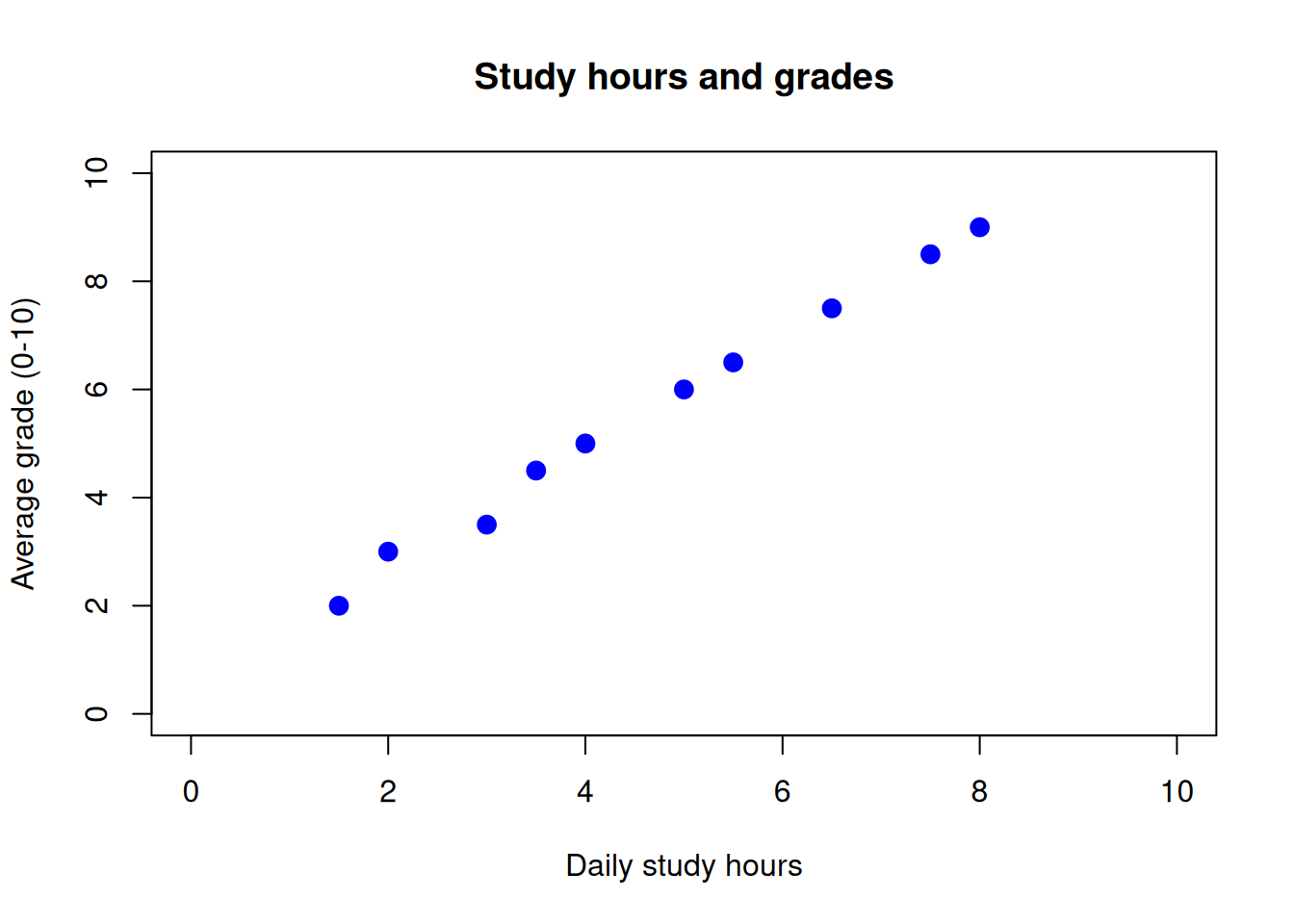
Suppose we collect data on ten students, recording for each one the number of hours studied per day ($X$) and the average grade obtained ($Y$, on a 0--10 scale).
```{r ch01-grades-data}
grades <- data.frame(
  study = c(1.5, 2.0, 3.0, 3.5, 4.0, 5.0, 5.5, 6.5, 7.5, 8.0),
  grade = c(2.0, 3.0, 3.5, 4.5, 5.0, 6.0, 6.5, 7.5, 8.5, 9.0)
)
grades
```
A table of numbers is hard to read at a glance; a picture is not. Plotting each student as a point makes the pattern immediate.
```{r ch01-grades-scatter}
#| fig-cap: "Daily study hours and average grade for ten students. Each dot is one student."
plot(grades$study, grades$grade,
     xlab = "Daily study hours",
     ylab = "Average grade (0-10)",
     main = "Study hours and grades",
     xlim = c(0, 10), ylim = c(0, 10),
     pch = 19, col = "blue", cex = 1.3)
```
The cloud of points slopes clearly upward: students who study more tend to earn higher grades. But a scatter plot only *shows* the relationship --- it does not yet *summarise* it in a number we can use to predict, compare, or inform a decision. To do that we need an **econometric model**.
## The econometric model
An econometric model splits the outcome $Y$, for each individual, into **two components**:
1. a **systematic component**, $f(X)$ --- the part of $Y$ that is related to the variables we have included in the model; and
2. an **unobserved component**, $u$ (also called the *error* or *disturbance*) --- all the other factors that affect $Y$ but are not in the model.
Compactly,
$$
Y = \underbrace{f(X)}_{\text{systematic component}} \;+\; \underbrace{u}_{\text{unobserved factors}}.
$$
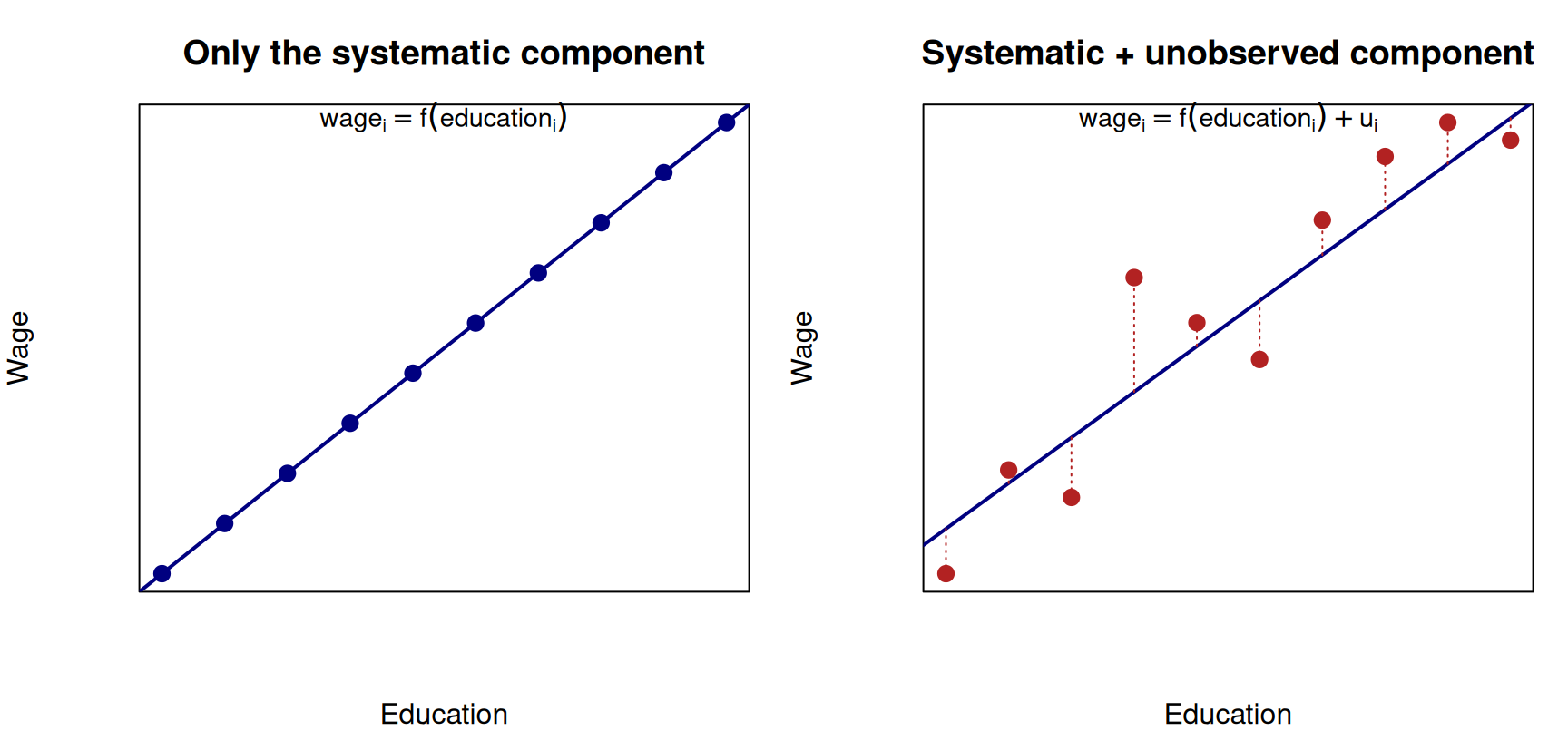
Why do we need the second term at all? Because no short list of variables ever fully determines an economic outcome. The next figure makes the point. On the left, education alone would fix wages exactly and every worker would sit precisely on the line. On the right --- the real world --- workers with the *same* education still earn *different* wages, and those vertical gaps are exactly the unobserved component $u$.
```{r ch01-two-component}
#| fig-cap: "Economic model vs. econometric model. Left: the systematic component alone would place every worker on the line. Right: the unobserved component u explains why workers with the same education earn different wages."
#| fig-width: 9
#| fig-height: 4.2
set.seed(1)
educ <- 1:10
wage_line <- 1 + 0.7 * educ

op <- par(mfrow = c(1, 2), mar = c(4, 4, 3, 1))

# Panel 1: systematic component only
plot(educ, wage_line,
     xlab = "Education", ylab = "Wage", main = "Only the systematic component",
     pch = 19, col = "navy", cex = 1.2, axes = FALSE)
box(); abline(1, 0.7, col = "navy", lwd = 2)
mtext(expression(wage[i] == f(education[i])), side = 3, line = -1, cex = 0.9)

# Panel 2: systematic + unobserved component
wage_obs <- wage_line + rnorm(10, 0, 1.1)
plot(educ, wage_obs,
     xlab = "Education", ylab = "Wage", main = "Systematic + unobserved component",
     pch = 19, col = "firebrick", cex = 1.2, axes = FALSE)
box(); abline(1, 0.7, col = "navy", lwd = 2)
segments(educ, wage_line, educ, wage_obs, col = "firebrick", lty = 3)
mtext(expression(wage[i] == f(education[i]) + u[i]), side = 3, line = -1, cex = 0.9)
par(op)
```
::: {.callout-note}
## Example: what is inside $u$?
Take the relationship Education $\Rightarrow$ Wage:
$$
\text{wage}_i = \underbrace{f(\text{education}_i)}_{\text{wage associated with education}} + \underbrace{u_i}_{\text{ability, experience, luck, family background, }\ldots}
$$
Two workers with identical schooling can earn very different wages because they differ in ability, experience, contacts, luck, and countless other factors we do not observe. All of these live in $u$. The same is true of our study-and-grades example: two students who study the same number of hours can still obtain different grades because of prior preparation, the difficulty of their courses, health, or plain luck --- everything not captured by study hours ends up in $u$.
:::
::: {.callout-warning}
## The error $u$ is unobservable
The systematic part $f(X)$ is built from variables we can measure. The error $u$ is not: it is a *population* object that collects everything we left out, and we never observe it directly. This is a point we will sharpen in Chapter 2, where we learn to estimate the model and distinguish the unobservable error $u$ from the quantities we can compute from a sample.
:::
## From a function to parameters
The model $Y = f(X) + u$ is not yet usable, because we have not said what the function $f$ looks like. The simplest and most common choice is a **straight line**. For the wage example,
$$
f(\text{education}_i) = \beta_0 + \beta_1\,\text{education}_i,
$$
so the model becomes
$$
\text{wage}_i = \beta_0 + \beta_1\,\text{education}_i + u_i.
$$
Here $\beta_0$ (the **intercept**) and $\beta_1$ (the **slope**) are **unknown population parameters**. The slope $\beta_1$ is the quantity we are usually after: it tells us how much wage changes, on average, with one more year of education. We do not know these numbers --- we **estimate** them from data using an econometric method. The standard method, Ordinary Least Squares (OLS), is the subject of Chapter 2; in this chapter we stop at *writing down* the model and *quantifying* the relationship with a correlation.
::: {.callout-note}
## The functional form is a hypothesis
Choosing $f(X) = \beta_0 + \beta_1 X$ is itself an assumption about how the world works --- namely, that the relationship is (at least approximately) linear. A good applied economist picks a functional form that is compatible both with economic reasoning and with what the data actually look like. We study richer, non-linear shapes in Chapter 6.
:::
## What econometrics is used for
We put econometric models to work for three broad purposes:
- **Testing economic theories and hypotheses.** Does raising the minimum wage reduce employment? Does class attendance improve grades?
- **Predicting economic variables.** Forecasting next quarter's GDP growth, or tomorrow's electricity demand.
- **Estimating causal effects.** Does an extra year of education *cause* higher wages, or are more-educated workers simply different to begin with?
The first two are the traditional business of econometrics. The third --- credible causal inference --- is the emphasis of the modern **Credibility Revolution** in empirical economics, which places causal questions at the centre and insists on research designs that can answer them convincingly [@cgl2017]. Sorting out *when* a relationship can be read causally is the theme of the next two sections.
## Correlation does not imply causation
The single most important lesson of the whole course is this: **two variables moving together does not mean that one causes the other**. It is worth repeating on every page.
::: {.callout-note}
## Example: ice cream and sunburn
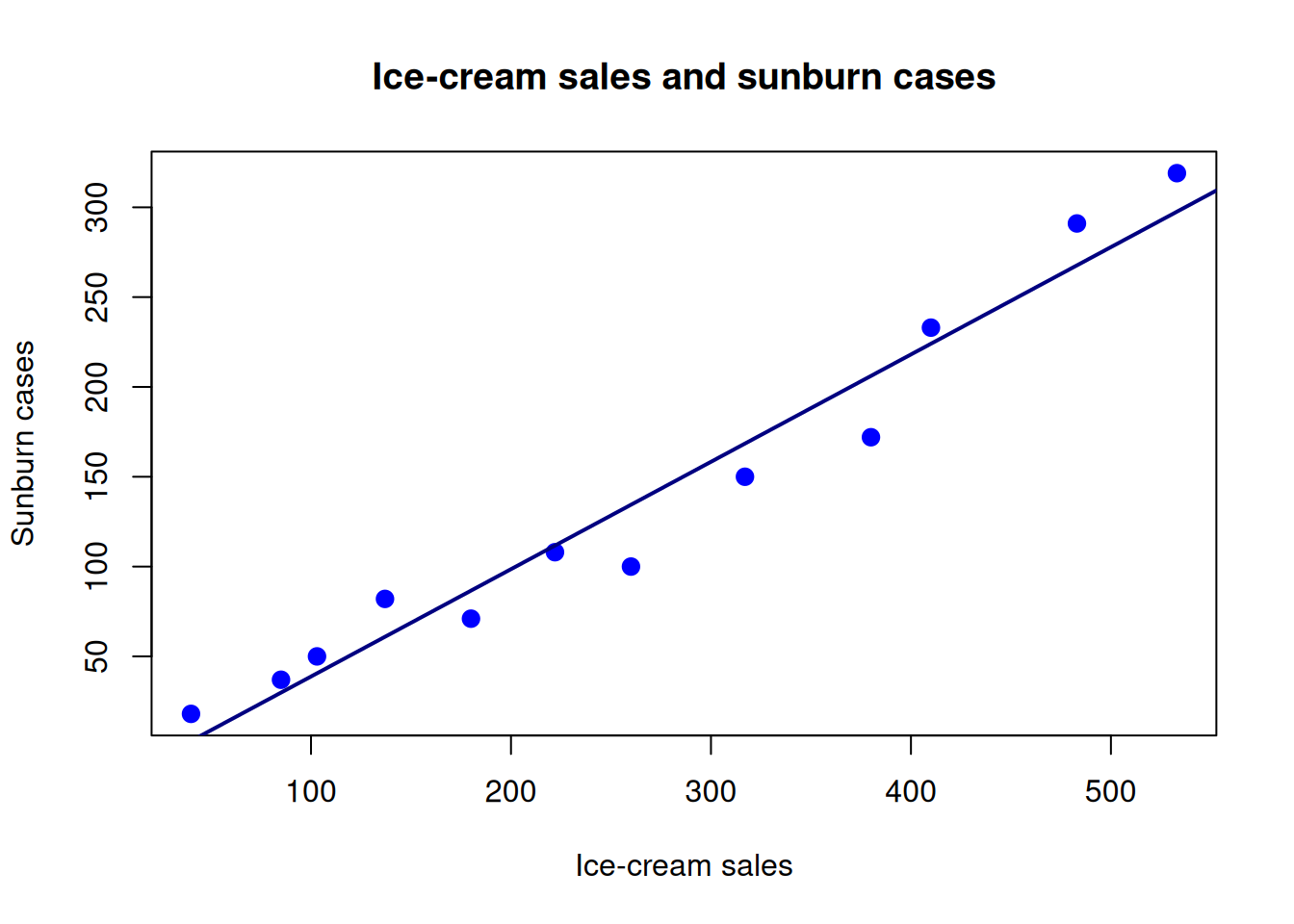
Collect monthly data on ice-cream sales and the number of sunburn cases, and plot them.
```{r ch01-icecream}
#| fig-cap: "Ice-cream sales and sunburn cases, by month (stylised data). The relationship in the data is clearly positive."
icecream <- c(40, 85, 137, 222, 317, 410, 533, 483, 380, 260, 180, 103)
sunburn  <- c(18, 37,  82, 108, 150, 233, 319, 291, 172, 100,  71,  50)
plot(icecream, sunburn,
     xlab = "Ice-cream sales", ylab = "Sunburn cases",
     main = "Ice-cream sales and sunburn cases",
     pch = 19, col = "blue", cex = 1.2)
abline(lm(sunburn ~ icecream), col = "navy", lwd = 2)
```
When ice-cream sales rise, sunburn cases rise too. If we fitted the econometric model
$$
\text{sunburn}_i = \beta_0 + \beta_1\,\text{icecream}_i + u_i,
$$
we would obtain an estimated slope $\hat\beta_1 > 0$. **But does ice cream cause sunburn?** Of course not. A third factor --- hot, sunny summer weather --- drives *both* ice-cream sales and sun exposure. The positive association is real, but it carries no causal meaning.
:::
Why does the distinction matter so much? **Because policy requires causality, not just correlation.** If we wrongly concluded that ice cream causes sunburn, we might propose banning ice-cream sales on the beach. That policy would do nothing for sunburn, because it does not touch the real cause. To reduce sunburn we should think about sunscreen, shade, and information --- the levers that actually operate on the outcome.
A second way a correlation can mislead us is that the causal arrow may run in the **opposite direction** to the one we assume.
::: {.callout-note}
## Example: hospital visits and health
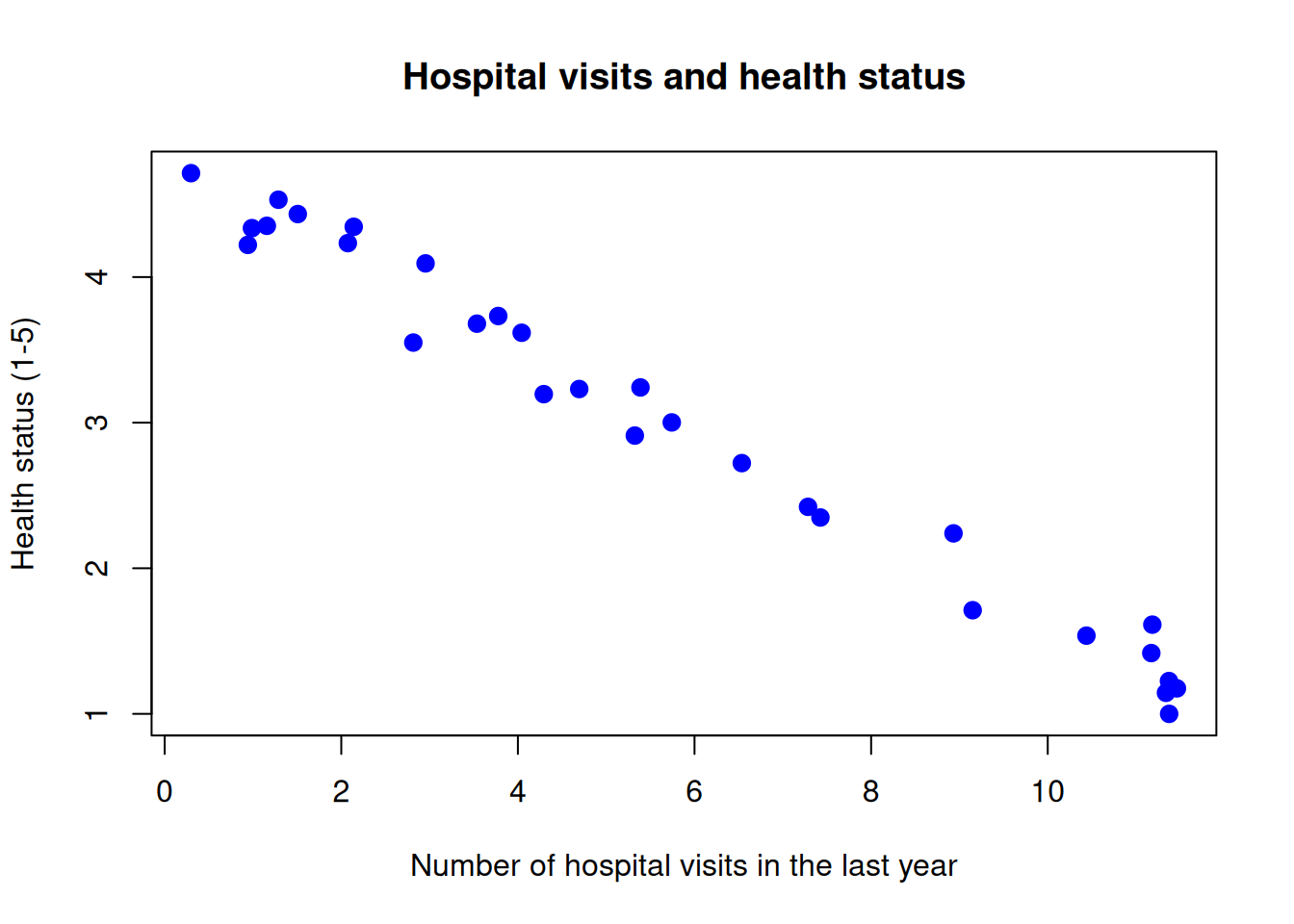
Suppose we study the relationship Hospital visits $\Rightarrow$ Health status and find that people who visit the hospital more often are, on average, *less* healthy.
```{r ch01-hospital}
#| fig-cap: "Hospital visits in the last year and health status (stylised data). The relationship in the data is negative."
set.seed(7)
visits <- sort(runif(30, 0.2, 11.5))
health <- pmin(pmax(4.7 - 0.30 * visits + rnorm(30, 0, 0.22), 1), 5)
plot(visits, health,
     xlab = "Number of hospital visits in the last year",
     ylab = "Health status (1-5)",
     main = "Hospital visits and health status",
     pch = 19, col = "blue", cex = 1.2)
```
Should we conclude that going to the hospital *ruins* your health, and recommend that people stay away? Clearly not. The arrow runs the other way: people who are already unwell go to the hospital more often. The relationship is genuine, but it reflects **reverse causation** --- health drives visits, not the reverse --- so the naive reading gives us exactly the wrong policy advice.
:::
::: {.callout-warning}
## Common mistake: reading a correlation as a causal effect
A strong correlation between $X$ and $Y$ tells us they *move together*. It does **not**, on its own, tell us that $X$ causes $Y$. The association may be produced by a lurking third factor (ice cream and sunburn), by reverse causation (hospital visits and health), or by both. Establishing causation takes more than a scatter plot --- it takes the right data and the right research design, which is where we turn next.
:::
How, then, could we ever settle a causal question? The honest answer is that it depends on the **kind of data** we have. That is not a detour from the causality discussion --- it is the continuation of it.
## Types of data in econometrics
In econometrics we work with two broad kinds of data, and the difference between them is exactly the difference between data that can, and data that usually cannot, answer a causal question on its own.
### Experimental data
In **experimental data**, the researcher *assigns* or *manipulates* the treatment, and the assignment can be **randomised**. Randomised experiments are considered the **gold standard** for estimating causal effects:
- The researcher controls who receives the **treatment**.
- Participants are split at random into a **treatment group** (which receives the intervention) and a **control group** (which does not).
- Because assignment is random, the two groups are, on average, **comparable before the treatment** --- they differ only by chance.
- Any difference in outcomes *after* the treatment can therefore be attributed to the treatment itself, with far greater credibility than in a simple comparison.
::: {.callout-warning}
## Random *sampling* is not random *assignment*
These two ideas sound alike and are constantly confused, but they do different jobs.
- **Random sampling** means drawing the individuals in our dataset at random from the population. It makes the sample *representative*, so our estimates generalise to the population.
- **Random assignment** means randomly deciding *which* sampled individuals receive the treatment. It makes the treatment and control groups *comparable*, which is what licenses a causal interpretation.
A perfectly representative survey (good sampling) still cannot, by itself, establish causation, because the people who happen to receive the "treatment" chose it themselves --- they were not assigned it at random.
:::
### Experiments are rare in the social sciences
Genuine randomised experiments are routine in medicine but **rare in economics and business**, for two reasons:
- **Ethics** --- we cannot randomly assign people to poverty, unemployment, or disease.
- **Cost and funding** --- well-designed field experiments are expensive and slow.
### Quasi-experiments
A useful middle ground sits between "pure" experiments and pure observation. In a **quasi-experiment**, assignment to treatment is *not* random, but neither is it chosen by the participants themselves: it is driven by some external, **observable** circumstance the researcher can exploit --- a policy change, a natural event, or an administrative rule such as a threshold or eligibility cut-off --- that happens to affect some units and not others.
::: {.callout-note}
## Example: a regional lockdown
During the COVID-19 pandemic, the *Junta de Andalucía* imposed a lockdown (the treatment) only on municipalities with an infection rate above 1,000 cases per 100,000 inhabitants. Municipalities just above and just below that threshold are otherwise quite similar, so comparing their outcomes can approximate a randomised experiment even though no one was assigned at random.
:::
### Non-experimental (observational) data
With **non-experimental** (or **observational**) data, the researcher simply observes what happens in the real world; all the variables are recorded simultaneously and the researcher fixes or manipulates nothing. Survey data are the classic example --- the U.S. Current Population Survey (CPS) and the Spanish *Encuesta de Población Activa* (EPA) both belong to this category. Most datasets in this book are non-experimental, which is precisely why the correlation-versus-causation warning matters so much.
### The structure of the data: cross-section, time-series, panel
Whatever its origin, a dataset has a **structure**. The three structures below are the ones we meet throughout the course, and telling them apart is essential because each answers a different kind of question.
**Cross-sectional data** are collected across many sample units --- individuals, firms, households, regions, countries --- in a *single* time period. A survey such as the CPS (United States) or the EPA (Spain) records, for a sample of individuals interviewed in the same period, variables such as education, sex, and wage:
```{r ch01-cross-section}
cross_section <- data.frame(
  Individual = 1:6,
  Education  = c("High school", "Bachelor's", "Master's",
                 "Bachelor's", "High school", "Master's"),
  Sex        = c("Female", "Male", "Female", "Male", "Male", "Female"),
  Wage       = c(12.5, 18.0, 24.3, 17.8, 11.2, 30.4)
)
knitr::kable(
  cross_section,
  align   = c("c", "l", "l", "r"),
  caption = "A cross-section: many units, all observed in one time period (illustrative data)."
)
```
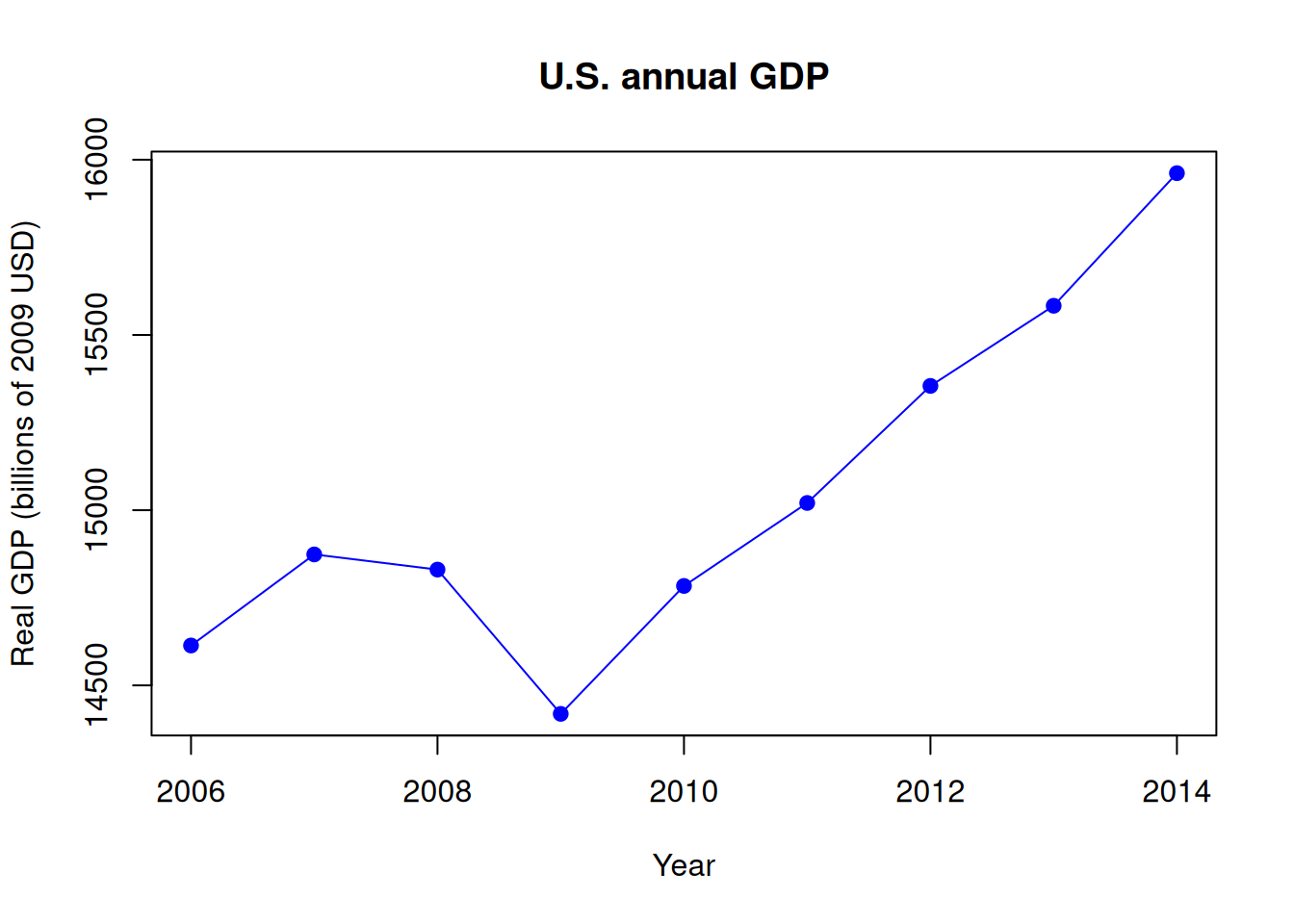
**Time-series data** record the *same* quantity at a regular time interval. U.S. annual real GDP is a familiar example:
```{r ch01-gdp-ts}
#| fig-cap: "A time series: U.S. annual real GDP (billions of 2009 dollars), 2006-2014."
gdp <- data.frame(
  year = 2006:2014,
  gdp  = c(14613.8, 14873.7, 14830.4, 14418.7, 14783.8,
           15020.6, 15354.6, 15583.3, 15961.7)
)
plot(gdp$year, gdp$gdp, type = "o",
     xlab = "Year", ylab = "Real GDP (billions of 2009 USD)",
     main = "U.S. annual GDP", pch = 19, col = "blue")
```
Other examples are the annual price of wheat, or the daily price of a company's shares. The defining feature is a *single* unit (here, the U.S. economy) observed *repeatedly over time*.
**Panel (or longitudinal) data** combine both dimensions: *many* units are followed *over several time periods*. The table below shows the output of two firms observed across several years --- each firm appears in more than one row, one row per year:
```{r ch01-panel}
panel <- data.frame(
  Firm   = c(1, 1, 1, 2, 2, 2),
  Year   = c(2019, 2020, 2021, 2019, 2020, 2021),
  Output = c(7.9, 7.2, 8.9, 10.4, 10.2, 13.3)
)
knitr::kable(
  panel,
  align   = c("c", "c", "r"),
  caption = "A panel: the same units (firms), each observed over several periods (illustrative data)."
)
```
If every unit is observed in every period, the panel is **balanced**; otherwise it is **unbalanced**. Usually the number of time periods is small relative to the number of units, but not always.
::: {.callout-warning}
## A panel is not a time series
"Data over time" is not automatically a time series. A time series follows *one* unit over many periods (U.S. GDP, year by year). A panel follows *many* units, each over several periods (many farms, each across years). The extra dimension is what gives panels their power: as we will see later in the book, they let us control for stable, unobserved differences between units.
:::
Two further labels are worth knowing. Data can be collected at different levels of **aggregation** --- *micro* (households, firms, workers) or *macro* (regions, countries) --- and variables can be **quantitative** (numbers, such as wage) or **qualitative** (categories, such as employed / unemployed).
The reason to keep all these distinctions straight is the single most useful sentence in the chapter: **the structure of the data determines which questions we can answer and which methods we can use.** Experimental data --- or a clever quasi-experiment --- can deliver credible causal effects; a single observational cross-section, by contrast, usually delivers correlations, and turning those into causal statements is the hard work of the rest of the course.
## Lab: exploring a dataset in R
We now return to the study-and-grades data from the start of the chapter and work through it as an applied economist would. The dataset is small enough to type in by hand, so no external package is needed. (Installing R and RStudio is covered in Appendix A; the first regression with `lm()` is the opening lab of Chapter 2.)
```{r ch01-lab-data}
grades <- data.frame(
  study = c(1.5, 2.0, 3.0, 3.5, 4.0, 5.0, 5.5, 6.5, 7.5, 8.0),
  grade = c(2.0, 3.0, 3.5, 4.5, 5.0, 6.0, 6.5, 7.5, 8.5, 9.0)
)
```
### What kind of data are these?
These are **non-experimental** data: we simply observed ten students; we did not assign anyone a number of study hours. In structure they are a **cross-section** --- ten different units (students), all observed in the same period, with no time dimension and no unit followed over time.
### Describing the two variables
For each variable we summarise its centre and its spread.
```{r ch01-lab-describe}
summary(grades)
sapply(grades, sd)
```
`summary()` reports the five-number summary --- minimum, first quartile, median, third quartile, and maximum --- together with the mean; it does **not** include the standard deviation, so we compute that separately with `sd()`, a measure of how spread out the values are.
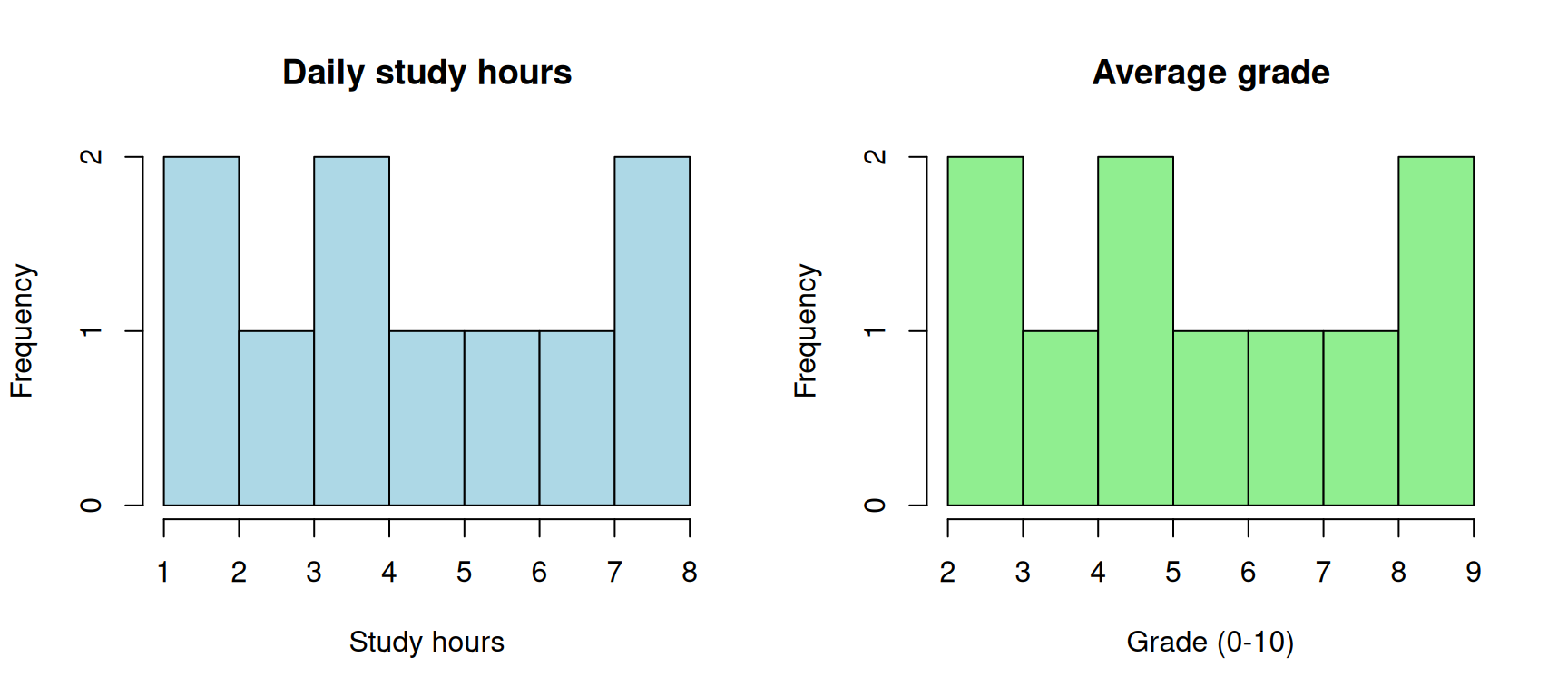
### The distribution of each variable
```{r ch01-lab-hist}
#| fig-cap: "Distributions of daily study hours and average grades."
#| fig-width: 9
#| fig-height: 4
op <- par(mfrow = c(1, 2))
hist(grades$study, breaks = 6, col = "lightblue",
     main = "Daily study hours", xlab = "Study hours")
hist(grades$grade, breaks = 6, col = "lightgreen",
     main = "Average grade", xlab = "Grade (0-10)")
par(op)
```
With only ten observations these histograms are necessarily coarse --- each bar holds just one or two students --- so treat them as a first look at the tool rather than a trustworthy picture of the underlying distribution, which needs many more data points to emerge.
### The relationship between them
```{r ch01-lab-scatter}
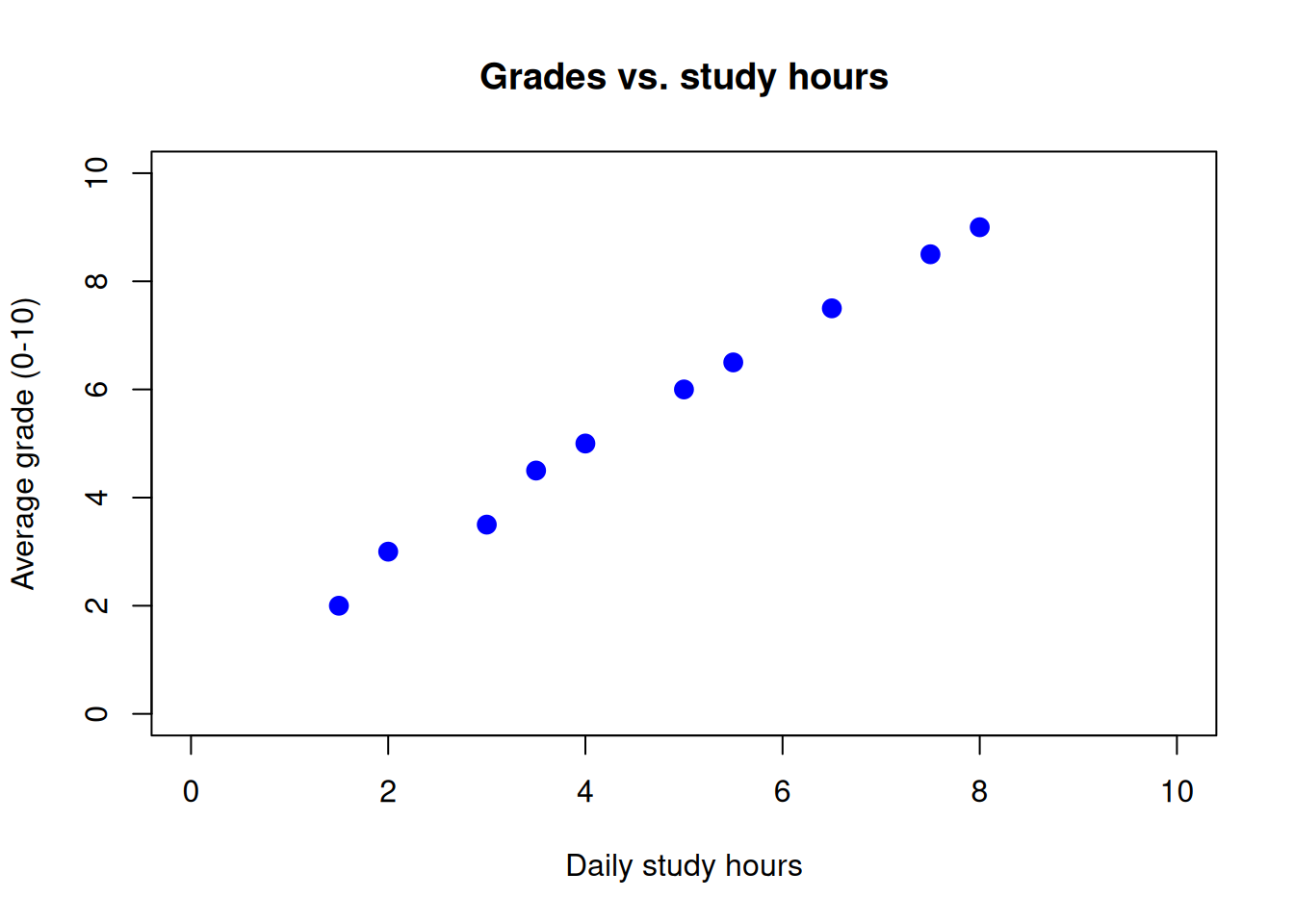
#| fig-cap: "Average grade against daily study hours."
plot(grades$study, grades$grade,
     xlab = "Daily study hours", ylab = "Average grade (0-10)",
     main = "Grades vs. study hours",
     xlim = c(0, 10), ylim = c(0, 10),
     pch = 19, col = "blue", cex = 1.3)
```
The scatter slopes upward, so the relationship is **positive**: more study hours go with higher grades. To put a single number on the *strength and direction* of a linear relationship, we compute the **sample correlation coefficient**, which always lies between $-1$ and $+1$:
```{r ch01-lab-cor}
cor(grades$study, grades$grade)
```
The correlation is very close to $+1$, confirming a strong, positive, and almost perfectly linear association in these (stylised) data.
Two cautions travel with this single number. First, the correlation coefficient captures only the strength of a *linear* association: a value near zero means there is no *linear* relationship, **not** that the two variables are unrelated. Earnings, for example, tend to rise with work experience and then flatten or fall near retirement --- a strong but curved (inverted-U) relationship that a correlation close to zero would entirely miss. Second, real economic data are far messier than these stylised numbers: a scatter of wages against education (Appendix A) is a diffuse cloud with a correlation nearer $0.4$ than $1$. We use tidy numbers here only so that the pattern --- and the R commands --- stand out clearly.
### Writing down an econometric model
A simple linear econometric model for these data is
$$
\text{grade}_i = \beta_0 + \beta_1\,\text{study}_i + u_i.
$$
The systematic part $\beta_0 + \beta_1\,\text{study}_i$ captures how grades move with study hours; the error $u_i$ collects everything else that affects a student's grade but is not in the model --- **innate ability, prior preparation, course difficulty, health, motivation, luck**. These omitted factors do not disappear; they simply live inside $u$.
### Can we conclude that studying *causes* better grades?
Not from these data alone. The students *chose* how much to study; they were not assigned their study hours at random. The more motivated or better-prepared students may both study more *and* score higher for reasons that have nothing to do with the extra hours --- and those reasons sit in $u$. What we have measured is a **correlation**, not a causal effect.
### How could we find the causal effect?
To isolate the causal effect of studying we would need an **experiment**. We could take a group of students, **randomly assign** some of them to a study programme (the treatment group) and leave the others as they are (the control group), and then compare the two groups' average grades. Because assignment is random, the two groups would be comparable to begin with, so a difference in their later grades could be credibly attributed to the extra studying. Designing such experiments --- and finding credible substitutes for them when they are impossible --- is a central task of modern econometrics.
## Self-check {.unnumbered}
Eight short multiple-choice questions. Try each one before opening the answer.
::: {.callout-tip collapse="true"}
## Q1. What does econometrics do?
The main objective of econometrics is to:
- A. Prove economic theories using only mathematics, without data.
- B. Estimate relationships between variables from data.
- C. Collect data without analysing it.
- D. Forecast the weather.
**Answer: B.** Econometrics applies statistical methods to economic data in order to estimate relationships between variables ($X \Rightarrow Y$).
:::
::: {.callout-tip collapse="true"}
## Q2. The two components of a model
In the econometric model $Y = f(X) + u$, the term $u$:
- A. Is the systematic part of the model.
- B. Can always be computed once we have the data.
- C. Collects the factors that affect $Y$ but are not included in the model.
- D. Is equal to zero for every individual.
**Answer: C.** The unobserved component $u$ gathers everything that influences $Y$ but is left out of the systematic part --- ability, luck, and so on. It is a population object and is not directly observable.
:::
::: {.callout-tip collapse="true"}
## Q3. Correlation and causation
A positive correlation between ice-cream sales and sunburn cases means that:
- A. Ice cream causes sunburn.
- B. Sunburn causes ice-cream sales.
- C. The two move together, but the association may be driven by a third factor such as hot weather.
- D. There is a mistake in the data.
**Answer: C.** The two variables move together because a lurking third factor --- summer heat --- drives both. Correlation alone says nothing about causation.
:::
::: {.callout-tip collapse="true"}
## Q4. Sampling vs. assignment
Which statement is correct?
- A. Random sampling and random assignment are the same thing.
- B. Random sampling makes the sample representative; random assignment makes treatment and control groups comparable.
- C. A representative survey is enough to establish a causal effect.
- D. Random assignment is only about how we draw the sample from the population.
**Answer: B.** Random *sampling* concerns representativeness; random *assignment* concerns comparability of the treated and untreated groups and is what licenses a causal reading. A representative survey alone does not deliver causation.
:::
::: {.callout-tip collapse="true"}
## Q5. Cross-section
A dataset with information on 526 workers interviewed in the same month (one row per worker) is:
- A. Cross-sectional data.
- B. Time-series data.
- C. Panel data.
- D. Experimental data.
**Answer: A.** Many units, one time period, no unit observed repeatedly --- the definition of a cross-section.
:::
::: {.callout-tip collapse="true"}
## Q6. Time series
U.S. annual GDP recorded every year from 2006 to 2014 is an example of:
- A. Cross-sectional data.
- B. Time-series data.
- C. Panel data.
- D. Experimental data.
**Answer: B.** A single quantity (GDP for one economy) recorded at a regular interval over time.
:::
::: {.callout-tip collapse="true"}
## Q7. Panel vs. time series
A dataset that follows 1,000 firms during 2010--2024, recording sales for each firm in every year, is:
- A. Time-series data, because it has a time dimension.
- B. Cross-sectional data, because each firm-year is one row.
- C. Panel (longitudinal) data: many units observed over several periods.
- D. Experimental data.
**Answer: C.** The same firms are tracked over multiple years, giving both a unit dimension and a time dimension. "Data over time" is not automatically a time series.
:::
::: {.callout-tip collapse="true"}
## Q8. Experiments and quasi-experiments
Which design gives the most credible evidence on a causal effect, by construction?
- A. A randomised experiment, where the treatment is assigned by lottery.
- B. A comparison of people who chose the treatment with those who did not.
- C. A single observational cross-section.
- D. A survey with a very large sample size.
**Answer: A.** Only random assignment makes the treatment and control groups comparable on average before treatment, which is why randomised experiments are the gold standard. A large sample (D) does not fix a non-random comparison (B, C).
:::
## Exercises {.unnumbered}
**Exercise 1.1 ★ --- Classifying datasets.** Classify each of the following as cross-sectional, time-series, or panel data.
(a) U.S. annual real GDP from 2006 to 2014.
(b) The study-and-grades data: ten students, one observation per student.
(c) The output of two rice farms recorded every year from 1990 to 1997.
(d) The wage, education, and sex of 500 individuals interviewed in a single CPS wave.
::: {.callout-tip collapse="true"}
## Show answer
(a) Time-series --- one quantity for one economy over time. (b) Cross-sectional --- many units, one period. (c) Panel --- the *same* farms observed over several years. (d) Cross-sectional --- many units, one time period.
:::
**Exercise 1.2 ★ --- Correlation or causation?** For each pair of variables, state (i) the likely sign of the correlation, and (ii) why the correlation should *not* be read as a causal effect. Name the lurking third factor or the direction of reverse causation.
(a) Ice-cream sales and sunburn cases.
(b) Number of hospital visits and health status.
(c) Number of firefighters sent to a fire and the amount of damage the fire causes.
::: {.callout-tip collapse="true"}
## Show answer
(a) Positive; a third factor --- hot, sunny weather --- drives both. (b) Negative; reverse causation --- people who are already unwell go to the hospital more, so health drives visits. (c) Positive; a third factor --- the size of the fire --- drives both the number of firefighters and the damage. Sending fewer firefighters would not reduce damage.
:::
**Exercise 1.3 ★ --- Sampling vs. assignment.** A researcher draws a large, perfectly representative random sample of workers and observes that those who attended a training course earn more than those who did not. Can the researcher conclude that the course *raised* wages? Explain, using the distinction between random sampling and random assignment.
::: {.callout-tip collapse="true"}
## Show answer
No. The sample is randomly *drawn* (good sampling, so it represents the population), but the workers *chose* whether to take the course --- the treatment was not randomly *assigned*. More motivated or more able workers may both enrol and earn more anyway; those factors sit in $u$. Without random assignment, the wage gap mixes the effect of the course with pre-existing differences between the two groups.
:::
**Exercise 1.4 ★★ --- Designing a randomised experiment.** You want to know whether a free study-skills workshop *causes* higher grades among first-year students. Sketch a randomised experiment that would identify this causal effect. Be explicit about: the participants, what is randomly assigned, the treatment and control groups, and the outcome you would compare. Mention one practical or ethical difficulty.
*A full answer is given in the Instructor Edition.*
**Exercise 1.5 ★★ --- Reading a model.** Consider the econometric model $\text{grade}_i = \beta_0 + \beta_1\,\text{study}_i + u_i$.
(a) In words, what does $\beta_1$ measure?
(b) Give three factors that would be contained in $u_i$.
(c) Explain why $\beta_0$ and $\beta_1$ are called *unknown parameters*.
::: {.callout-tip collapse="true"}
## Show answer
(a) $\beta_1$ is the change in the average grade associated with one more daily hour of study. (b) Any three of: innate ability, prior preparation, course difficulty, health, motivation, luck. (c) They are fixed features of the population that we do not know; we estimate them from a sample using an econometric method (OLS, Chapter 2).
:::
**Exercise 1.6 ★★★ --- Chocolate and Nobel prizes.** It has been noted that countries with higher per-capita chocolate consumption also win more Nobel prizes per capita [@cgl2017]. Is this evidence that eating chocolate causes Nobel prizes? Identify (i) at least one plausible lurking third factor, and (ii) explain why a randomised experiment to settle the question would be difficult to run in practice.
*A full answer is given in the Instructor Edition.*