---
title: "Inference"
---
## Learning outcomes {.unnumbered}
By the end of this chapter the reader should be able to:
- Explain why an estimate $\hat{\beta}_j$ is subject to **sampling uncertainty**, and read the standard error as the spread of the estimator's sampling distribution.
- State the Classical Linear Model assumptions (MLR.1--MLR.6) and explain what the normality assumption MLR.6 adds to Gauss--Markov.
- Derive the sampling distribution of $\hat{\beta}_j$ under the CLM and explain why standardisation produces a $t_{n-k-1}$ statistic rather than a standard normal.
- Construct and interpret a $(1-\alpha)\times 100\%$ confidence interval for an individual coefficient, and find the critical value $t_c$ from the $t$-table.
- Run a four-step hypothesis test (two-sided and one-sided) for a single coefficient, and read off the corresponding $p$-value.
- Carry out an $F$-test for joint significance, distinguishing the overall $F$-test from a restricted-vs-unrestricted comparison.
- Reproduce all of the above in R on the `beauty` wage regression, using `summary()`, `confint()`, `qt()`, `pt()`, `anova()` and manual arithmetic on the fitted model.
## Motivating empirical question {.unnumbered}
> *A simple regression of completed fertility on schooling gives a slope of $-0.139$: in this sample, women with more education have fewer children. But if we drew a different sample, would we get $-0.139$ again --- or could the true population slope be $0$, with $-0.139$ just the luck of the draw?*
Every estimate in this course is computed from *one* sample, and a different sample would have given a different number. Inference is the discipline that turns a single estimate into a credible statement about the unknown population parameter behind it. The tools of the chapter --- the standard error, confidence intervals, $t$-statistics, $p$-values and the $F$-test --- are built precisely for that job. We will answer the fertility question directly, and in the lab we turn the same machinery on the `beauty` wage regression we met in Chapter 2 and will revisit in Chapter 6.
## From estimation to inference
`\lettrine[lines=3]{E}{very}`{=latex}`<span class="dropcap">E</span>very`{=html} point estimate in Chapters 2 and 3 was computed from a single sample, and is therefore **random**: draw another sample from the same population and the arithmetic returns a different number. This is the heart of the matter. The population coefficient $\beta_j$ is a *fixed, unknown* feature of the world; the estimator $\hat{\beta}_j$ is a *random* quantity that varies from sample to sample. Inference is the study of that sample-to-sample variation.
Imagine --- as a thought experiment --- drawing many independent samples and estimating the same regression in each. The estimates do not all coincide; they scatter. Collected together they form the **sampling distribution** of $\hat{\beta}_j$: under MLR.1--MLR.4 it is centred on the true $\beta_j$ (OLS is unbiased), and its spread measures how much $\hat{\beta}_j$ typically moves when the sample changes. That spread has a name.
::: {.callout-note}
## Definition: the standard error
The **standard error** $\operatorname{se}(\hat{\beta}_j)$ is the estimated standard deviation of the sampling distribution of $\hat{\beta}_j$ --- a measure of how much the estimate would vary from one random sample to the next. A *wider* sampling distribution means a *larger* standard error and a *less precise* estimate.
:::
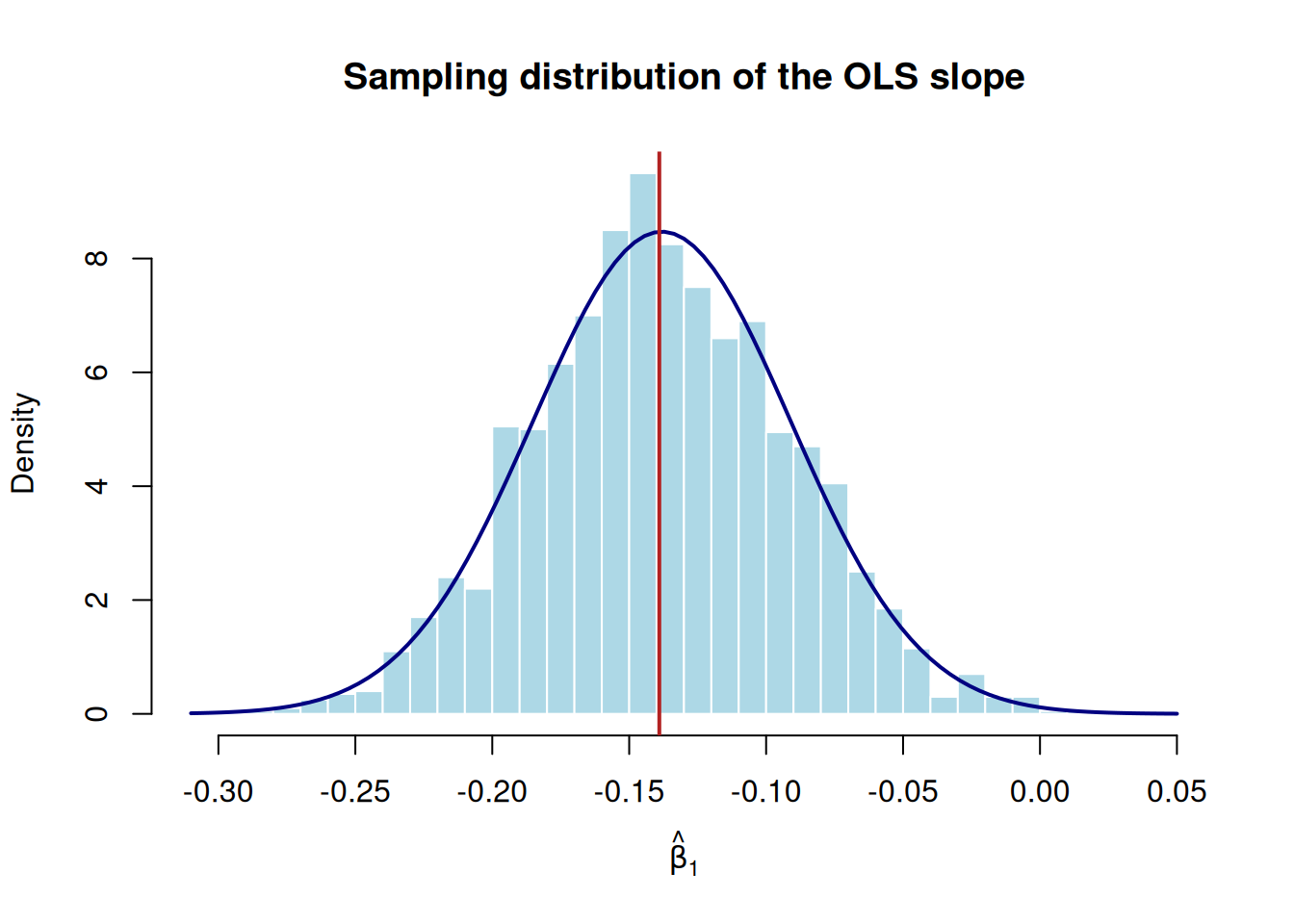
The figure below makes the thought experiment concrete. Each of two thousand simulated samples produces its own slope estimate; the estimates pile up into a bell-shaped distribution centred on the true slope.
```{r ch04-fig-sampling}
#| fig-cap: "Two thousand OLS slope estimates, each from an independently simulated sample (illustrative, n = 200) of a fertility-style regression with true slope -0.139 (red line). The estimates pile up into a bell-shaped sampling distribution; its spread is what the standard error measures."
set.seed(4)
beta1_true <- -0.139
n   <- 200
reps <- 2000
bhat <- numeric(reps)
for (r in 1:reps) {
  x <- rnorm(n, mean = 12, sd = 3)      # e.g. years of schooling
  u <- rnorm(n, mean = 0,  sd = 2)      # unobserved factors
  y <- 4.51 + beta1_true * x + u
  bhat[r] <- coef(lm(y ~ x))[2]
}
hist(bhat, breaks = 40, freq = FALSE,
     col = "lightblue", border = "white",
     main = "Sampling distribution of the OLS slope",
     xlab = expression(hat(beta)[1]))
curve(dnorm(x, mean = mean(bhat), sd = sd(bhat)),
      add = TRUE, col = "navy", lwd = 2)
abline(v = beta1_true, col = "firebrick", lwd = 2)
```
Knowing the *centre* and *spread* of the sampling distribution is not yet enough: to compute probabilities --- "how likely is an estimate this far from zero if the truth were zero?" --- we need its *shape*. Once we have it, statistical inference offers two complementary tools [@wooldridge2020], both built from the same two ingredients, $\hat{\beta}_j$ and $\operatorname{se}(\hat{\beta}_j)$:
1. **Confidence intervals.** A range of plausible values for the unknown $\beta_j$, with a calibrated long-run coverage probability.
2. **Hypothesis tests** ($t$-tests and $F$-tests). A formal procedure for deciding whether a specific claim about $\beta_j$ is compatible with the data.
The next assumption supplies the missing shape.
## The Classical Linear Model (CLM) assumptions
Gauss--Markov gave us unbiasedness, a closed-form variance and the BLUE property of OLS. For exact (finite-sample) inference we need one more assumption.
::: {.callout-note}
## Definition: MLR.6 (Normality of the error term)
The population error $u$ is independent of the regressors $\mathbf{X}$ and normally distributed with mean zero and constant variance:
$$
u \mid \mathbf{X} \;\sim\; \mathcal{N}(0,\,\sigma^2).
$$
The full set MLR.1--MLR.6 is called the **Classical Linear Model (CLM) assumptions**.
:::
Why normality, and where does it come from? In many applied settings $u$ is a sum of a large number of small, independent omitted factors, and a central-limit heuristic suggests its distribution should be roughly bell-shaped. The assumption is strong: it can fail badly for skewed outcomes such as wages or counts. We will see in Chapter 6 that taking $\log$ of the dependent variable often does a lot to make the residuals look symmetric.
The pay-off is large. Under MLR.1--MLR.6 the OLS estimator inherits the normality of $u$:
$$
\hat{\beta}_j \mid \mathbf{X} \;\sim\; \mathcal{N}\!\left(\beta_j,\,\operatorname{Var}(\hat{\beta}_j)\right).
$$
This is an *exact* statement that holds in any sample size, not just asymptotically. With $n$ large, the central limit theorem delivers approximately the same conclusion even without MLR.6, but only the CLM gives us exact small-sample inference.
::: {.callout-warning}
## Common mistake: confusing the normality of $u$ with the normality of $y$
MLR.6 is a statement about the *error* $u$, conditional on the regressors. It is *not* the claim that the marginal distribution of $y$ is normal. Wages, for example, are right-skewed; that does not by itself contradict MLR.6, because the systematic component $\beta_0 + \beta_1 x_1 + \cdots$ can absorb the skewness.
:::
## The $t$-distribution
If $\sigma^2$ were known we could standardise $\hat{\beta}_j$ directly:
$$
Z \;=\; \frac{\hat{\beta}_j - \beta_j}{\sqrt{\operatorname{Var}(\hat{\beta}_j)}} \;\sim\; \mathcal{N}(0,1).
$$
In practice $\sigma^2$ is unknown and is replaced by the OLS estimator $\hat{\sigma}^2 = \mathrm{SSR}/(n-k-1)$. Plugging $\hat{\sigma}^2$ into the standard error introduces an extra source of variability, and the standardised statistic is no longer standard normal: it is **$t$-distributed** with $n-k-1$ degrees of freedom,
$$
t \;=\; \frac{\hat{\beta}_j - \beta_j}{\operatorname{se}(\hat{\beta}_j)} \;\sim\; t_{\,n-k-1}.
$$
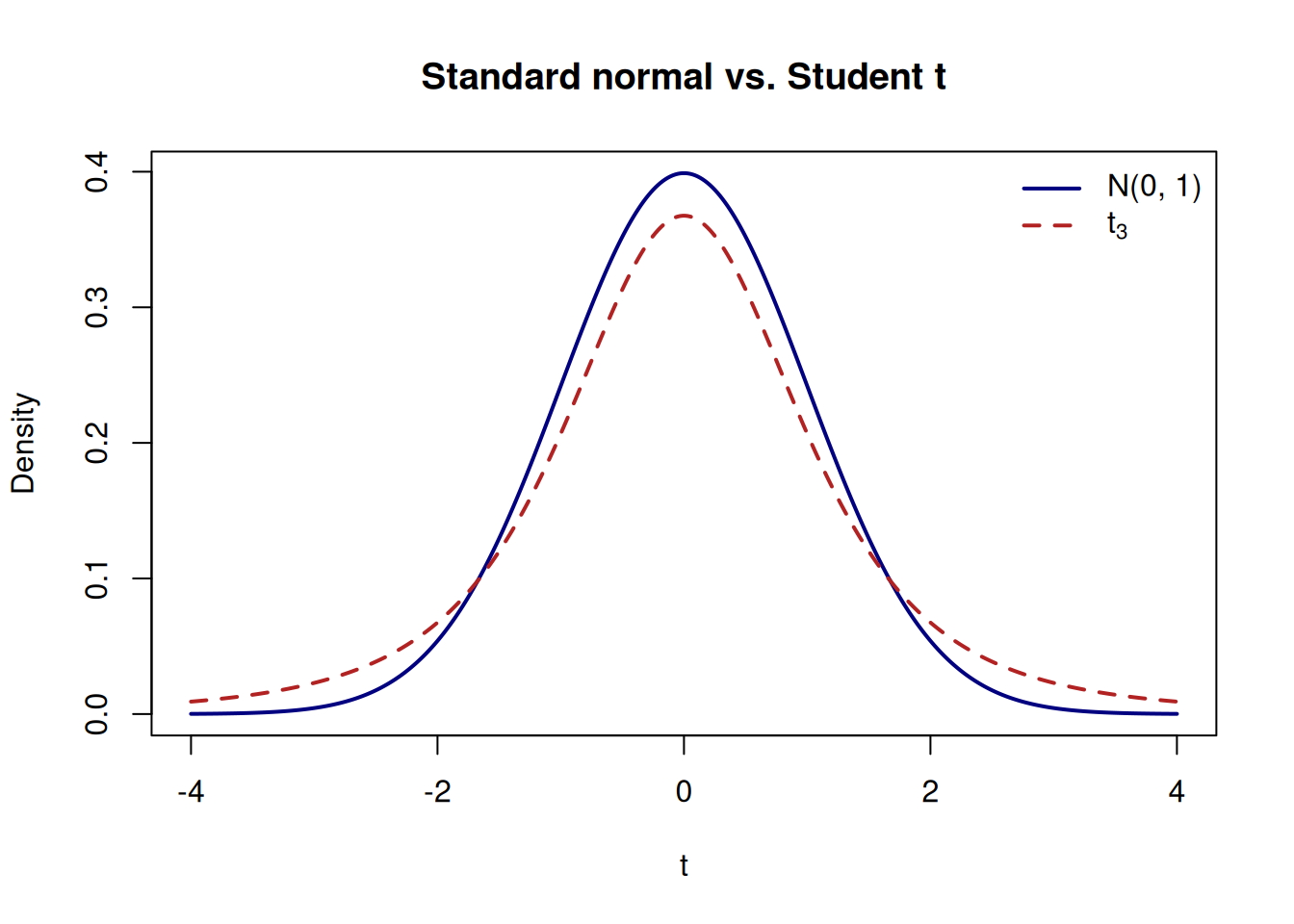
Here $k$ is the number of regressors *excluding* the intercept, so $k+1$ coefficients are estimated and $n-k-1$ observations' worth of information is left over. The $t$-distribution is symmetric, bell-shaped and centred at zero, but it has **heavier tails** than $\mathcal{N}(0,1)$ --- a reflection of the extra uncertainty from estimating $\sigma^2$. As the degrees of freedom grow, the tails thin out and $t_{n-k-1}$ converges to $\mathcal{N}(0,1)$: for $n-k-1 \geq 120$ the two are virtually indistinguishable, while for small samples the $t$ is noticeably wider.
```{r ch04-fig-normal-t}
#| fig-cap: "Standard normal against Student t with 3 degrees of freedom. The two share the same bell shape, but the t puts more probability in the tails; as the degrees of freedom grow the curves become indistinguishable."
x <- seq(-4, 4, length.out = 400)
plot(x, dnorm(x), type = "l", lwd = 2, col = "navy",
     xlab = "t", ylab = "Density",
     main = "Standard normal vs. Student t")
lines(x, dt(x, df = 3), lwd = 2, lty = 2, col = "firebrick")
legend("topright", bty = "n", lwd = 2, lty = c(1, 2),
       col = c("navy", "firebrick"),
       legend = c("N(0, 1)", expression(t[3])))
```
It is because of these heavier tails that a 95% interval uses a $t$ critical value --- $2.014$ for $df = 45$, say --- rather than the familiar $1.96$ from the normal table, with the gap shrinking as the sample grows.
## Confidence intervals
A point estimate reports a single number but hides its uncertainty. A confidence interval repairs this by reporting a *range* of plausible values for $\beta_j$. The idea is the same one that underlies every interval estimate:
$$
\text{estimate} \;\pm\; \text{margin of error}.
$$
The estimate sits at the centre; the margin of error is built from the standard error, so a *wider* sampling distribution gives a *wider* interval. Making this precise gives the formula below.
::: {.callout-note}
## Definition: confidence interval for $\beta_j$
A $(1-\alpha)\times 100\%$ confidence interval for $\beta_j$ is
$$
\hat{\beta}_j \;\pm\; t_c\,\cdot\,\operatorname{se}(\hat{\beta}_j),
\qquad t_c = t_{\alpha/2,\,n-k-1},
$$
where $\alpha$ is the **significance level** and $t_c$ is the critical value of the $t$-distribution that leaves probability $\alpha/2$ in each tail.
:::
For the canonical 95% interval, $\alpha = 0.05$ and the critical value is $t_{0.025,\,n-k-1}$. With moderately large samples this is close to $1.96$, but in small samples it can be appreciably larger. Finding $t_c$ is a short, mechanical procedure.
::: {.callout-note}
## How to find the critical value $t_c$
The critical value depends on three things: the significance level $\alpha$, the number of tails, and the degrees of freedom.
1. **Choose the significance level** $\alpha = 1 - \text{confidence level}$. For a 95% interval, $\alpha = 1 - 0.95 = 0.05$.
2. **Decide one- or two-sided.** A two-sided interval or test splits $\alpha$ between the two tails, so use $\alpha/2$; a one-sided test uses $\alpha$. For a 5% two-sided interval, $\alpha/2 = 0.025$.
3. **Compute the degrees of freedom** $df = n-k-1$.
4. **Read the $t$-table.** Find the row for $df$ and the column for the tail probability ($\alpha$ one-sided, $\alpha/2$ two-sided). The table of $t$ critical values is in Appendix C.
:::
::: {.callout-warning}
## Common mistake: misreading the "95%"
A 95% confidence interval is a statement about the **procedure**, not about the one realised interval. If we drew many independent samples and built one interval from each, about 95% of those intervals would contain the true $\beta_j$. It is **not** correct to say that there is a 95% probability that the particular interval $[L, U]$ we computed from our one sample contains $\beta_j$: once computed, $\beta_j$ is a fixed (if unknown) number, and this interval either covers it or it does not. The 95% is a property of the method, not of any single interval.
:::
::: {.callout-note}
## Example: a 95% interval for the fertility slope
A simple model relates completed fertility to schooling, $\text{children} = \beta_0 + \beta_1\,\text{educ} + u$. One sample gives (standard errors underneath):
$$
\widehat{\text{children}} \;=\; \underset{(0.23)}{4.51} \;-\; \underset{(0.018)}{0.139}\,\text{educ},
\qquad n = 1129.
$$
For a two-sided 95% interval, $\alpha/2 = 0.025$ and $df = n-k-1 = 1129-1-1 = 1127$, so $t_c \approx 1.96$. The interval for $\beta_1$ is
$$
-0.139 \;\pm\; 1.96 \times 0.018 \;=\; -0.139 \pm 0.0353 \;=\; [\,-0.174,\ -0.104\,].
$$
With 95% confidence, this procedure brackets $\beta_1$ in a range of entirely *negative* values. The interval excludes $0$, a fact we return to below.
:::
## Hypothesis testing in four steps
A confidence interval summarises *all* the values of $\beta_j$ the data find plausible. Often, though, we want to evaluate one specific claim --- most commonly, that a coefficient equals zero (the variable "does not matter"), or more generally that $\beta_j = c$ for some value $c$ fixed by theory. A hypothesis test asks a single pointed question:
> *If this claim were true, would our sample estimate be surprising?*
To answer it we compare $\hat{\beta}_j$ with the claimed value $c$, measured in standard-error units. That distance is the **$t$-statistic**,
$$
t \;=\; \frac{\hat{\beta}_j - c}{\operatorname{se}(\hat{\beta}_j)}.
$$
A large $|t|$ means that an estimate as far from $c$ as the one we obtained would be unusual if $\beta_j = c$ were really true --- evidence against the claim. We make this operational in four steps.
**Step 1. State $H_0$ and $H_1$.** The **null hypothesis** fixes a value, always as an equality, and the test is conducted *assuming $H_0$ is true*:
$$
H_0:\ \beta_j = c.
$$
The **alternative hypothesis** is the complementary inequality, in one of three forms:
- *Two-sided:* $H_1: \beta_j \neq c$.
- *Right one-sided:* $H_1: \beta_j > c$.
- *Left one-sided:* $H_1: \beta_j < c$.
The choice between one- and two-sided is driven by **economic theory**, not by the data: if theory tells us a priori that $\beta_j$ cannot be positive, a left-sided test is appropriate. The conclusion is only ever *reject $H_0$* or *fail to reject $H_0$* --- we never "accept" $H_1$.
**Step 2. Find the critical value.** Pick $\alpha$ (default $0.05$) and read $t_c$ from the $t$-table with $n-k-1$ degrees of freedom, using the tail probability for the case at hand: $\alpha/2$ for a two-sided test, $\alpha$ for a one-sided test (see Appendix C).
**Step 3. Compute the $t$-statistic.**
$$
t \;=\; \frac{\hat{\beta}_j - c}{\operatorname{se}(\hat{\beta}_j)}.
$$
For the default $c = 0$ this reduces to $t = \hat{\beta}_j / \operatorname{se}(\hat{\beta}_j)$, which is exactly the number R reports in the third column of `summary(lm(...))`.
**Step 4. Compare and conclude.** Apply the rejection rule for the chosen $H_1$:
| case | $H_1$ | reject $H_0$ if |
|---|---|---|
| Right-tailed | $\beta_j > c$ | $t > t_c$, with $t_c = t_{\alpha,\,n-k-1}$ |
| Left-tailed | $\beta_j < c$ | $t < -t_c$, with $t_c = t_{\alpha,\,n-k-1}$ |
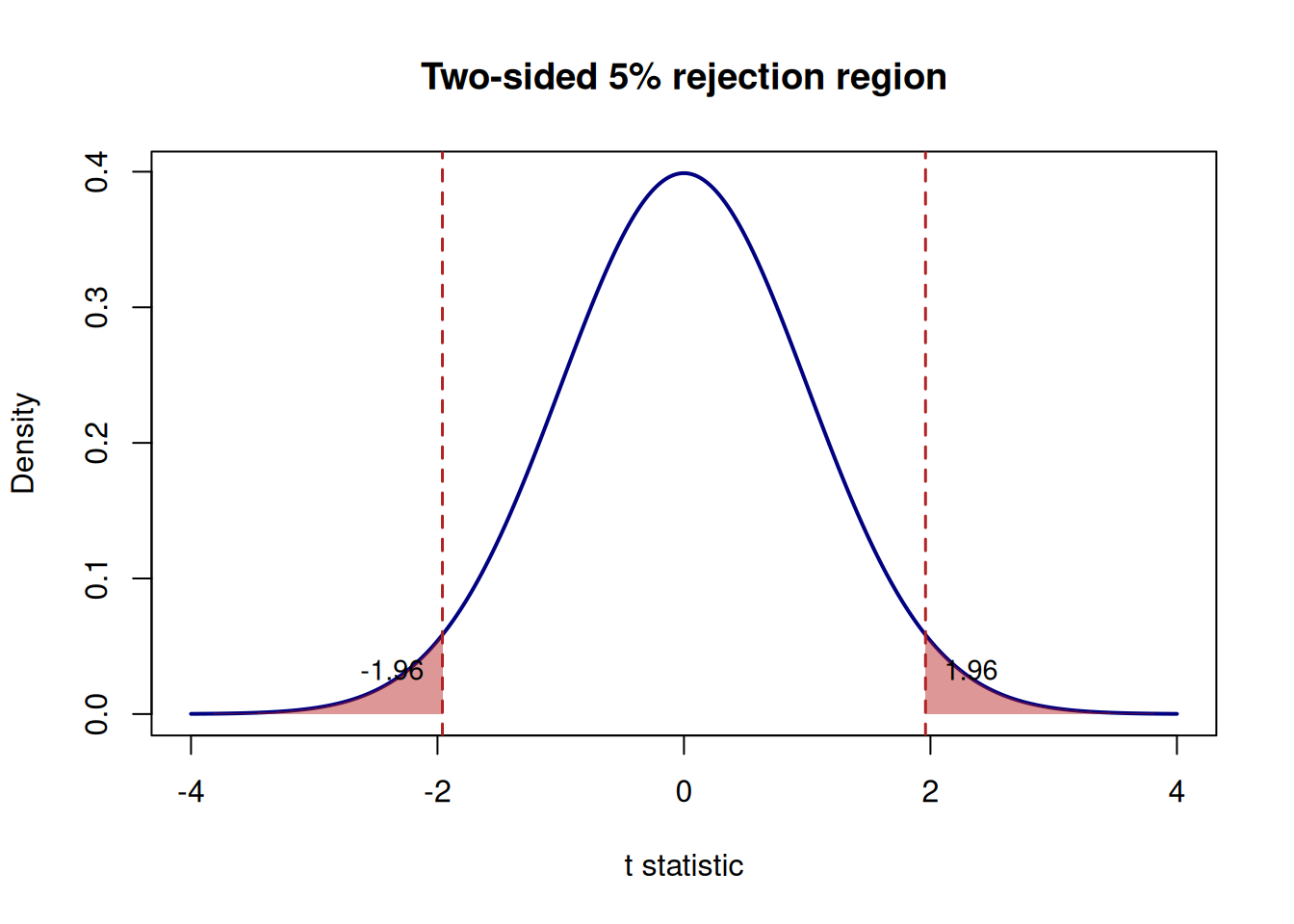
| Two-tailed | $\beta_j \neq c$ | $\lvert t\rvert > t_c$, with $t_c = t_{\alpha/2,\,n-k-1}$ |
```{r ch04-fig-rejection}
#| fig-cap: "The two-sided 5% rejection region. A statistic landing in either shaded tail rejects the null; with large degrees of freedom the critical values are the standard-normal values +/-1.96 shown here."
x <- seq(-4, 4, length.out = 400)
plot(x, dnorm(x), type = "l", lwd = 2, col = "navy",
     xlab = "t statistic", ylab = "Density",
     main = "Two-sided 5% rejection region")
tc <- 1.96
xl <- seq(-4, -tc, length.out = 120)
polygon(c(xl, rev(xl)), c(dnorm(xl), rep(0, length(xl))),
        col = rgb(0.70, 0.10, 0.10, 0.45), border = NA)
xr <- seq(tc, 4, length.out = 120)
polygon(c(xr, rev(xr)), c(dnorm(xr), rep(0, length(xr))),
        col = rgb(0.70, 0.10, 0.10, 0.45), border = NA)
abline(v = c(-tc, tc), col = "firebrick", lwd = 1.5, lty = 2)
text(c(-tc, tc), 0.03, labels = c("-1.96", "1.96"),
     pos = c(2, 4), cex = 0.9)
```
If $H_0$ is rejected we say the coefficient is *statistically significant* at level $\alpha$. If we fail to reject we say the data are *consistent with* $H_0$ --- never that we have "proved" it.
::: {.callout-note}
## Example: is the fertility slope below zero?
Take the same fertility estimates. Theory suggests schooling does not *raise* fertility, so we test against a *negative* alternative --- a **left-tailed** test:
$$
H_0:\ \beta_1 = 0 \qquad\text{vs.}\qquad H_1:\ \beta_1 < 0.
$$
- **Step 2.** $df = 1129-1-1 = 1127$ and $\alpha = 0.05$ in *one* tail, so from the $t$-table $t_c \approx 1.645$.
- **Step 3.** $\displaystyle t = \frac{-0.139 - 0}{0.018} = -7.72.$
- **Step 4 (left-tailed, reject if $t < -t_c$).** $-7.72 < -1.645$, so we **reject $H_0$**.
At the 5% level $\hat{\beta}_1$ is statistically significant: the data are hard to reconcile with $\beta_1 = 0$.
:::
What does rejecting $H_0$ here actually buy us? It says that, given the sampling uncertainty, $\beta_1 = 0$ is implausible --- the estimated *negative association* between schooling and fertility is distinguishable from zero. It does **not** say that schooling *causes* lower fertility (there is no causal identification in a single regression of this kind), that the result automatically carries over to other populations, or anything about the *size* of the effect. Those are separate questions, taken up below and in later chapters.
::: {.callout-warning}
## Common mistake: "fail to reject" is not "prove $H_0$"
When $|t|$ is small we **fail to reject** $H_0$. The correct reading is "the data do not provide enough evidence against $H_0$", **not** "we have proved $H_0$ is true". A small $|t|$ can arise simply because the sample is too small or too noisy to detect a departure from $c$ --- absence of evidence is not evidence of absence.
:::
## Confidence intervals and two-sided tests
Confidence intervals and two-sided tests are not two separate procedures; they are two views of the same comparison.
::: {.callout-note}
## Equivalence
For a two-sided test of $H_0:\beta_j = c$ at level $\alpha$,
$$
\text{reject } H_0 \quad\Longleftrightarrow\quad c \text{ lies outside the } (1-\alpha) \text{ confidence interval.}
$$
:::
The 95% fertility interval was $[-0.174,\ -0.104]$. Does it contain $0$? No --- so the two-sided test of $H_0:\beta_1 = 0$ rejects at the 5% level, with no extra arithmetic.
::: {.callout-warning}
## Careful: which test is this?
Our worked test of $H_0:\beta_1 = 0$ above was **one-tailed** ($H_1:\beta_1 < 0$, $t_c = 1.645$). The equivalence just stated is for the **two-sided** test ($H_1:\beta_1 \neq 0$, $t_c = 1.96$). Both reject here, but they are *different* tests --- only the two-sided one lines up with the 95% confidence interval.
:::
## The $p$-value
The four-step procedure forces us to fix $\alpha$ in advance. A more informative alternative is to report the $p$-value.
::: {.callout-note}
## Definition: $p$-value
The $p$-value is the probability, computed *under $H_0$*, of observing a test statistic at least as extreme as the one we got. Equivalently, it is the *smallest* significance level $\alpha$ at which we would reject $H_0$.
:::
For a two-sided test of $H_0:\beta_j = 0$ with computed statistic $t$,
$$
p \;=\; 2 \cdot \Pr\!\left(T_{n-k-1} > |t|\right),
$$
and for a one-sided test the $p$-value is half of this (when the sign of $\hat{\beta}_j$ agrees with the alternative). The decision rule is simply
$$
p < \alpha \;\Rightarrow\; \text{reject}, \qquad p \geq \alpha \;\Rightarrow\; \text{fail to reject}.
$$
Conventional rules of thumb [@wooldridge2020]: $p < 0.01$ is strong evidence against $H_0$; $p < 0.05$ is evidence against it; $p < 0.10$ is weak evidence; $p \geq 0.10$ is insufficient to reject. R reports two-sided $p$-values by default in the `Pr(>|t|)` column of `summary(lm(...))`, with significance stars (`***` for $p < 0.001$, `**` for $p < 0.01$, `*` for $p < 0.05$, `.` for $p < 0.10$).
::: {.callout-warning}
## Common mistake: the $p$-value is not the probability that $H_0$ is true
A $p$-value of $0.024$ does **not** mean "there is a 2.4% probability that $H_0$ is true". The $p$-value is computed *assuming* $H_0$ is true; it is a statement about the data under the null, not a probability assigned to the null itself. Nor does a small $p$-value certify causation: it tells us $\hat{\beta}_j$ is unlikely to have arisen by sampling noise if the truth were zero, but says nothing about whether $x_j$ *causes* $y$. Causal interpretation still requires the population assumption $\mathbb{E}[u \mid \mathbf{X}] = 0$ (MLR.4) --- no $p$-value, however small, can rescue a regression contaminated by omitted-variable bias or reverse causation.
:::
## Statistical versus economic significance
Statistical significance and *economic* (practical) significance are different questions, and a good empirical analysis always asks both.
- **Statistical significance** asks: can we distinguish the coefficient from zero? This is driven by the standard error, hence by the $p$-value.
- **Economic significance** asks: is the *size* of the coefficient large enough to matter for the decision at hand?
The two can come apart because a very large sample shrinks $\operatorname{se}(\hat{\beta}_j)$, so even a *tiny* coefficient can be statistically significant. A precisely estimated $\hat{\beta} = 0.0004$ may be "significantly different from zero" and yet economically negligible.
::: {.callout-warning}
## Common mistake: reading significance as importance
A coefficient can be statistically significant (small $p$-value) but economically trivial, and a coefficient can be economically large but statistically insignificant in a small sample. Always report both: the *magnitude* of $\hat{\beta}_j$ in the units of the problem, and the precision with which it is estimated. A 1% and a 10% return to a year of schooling may both be "significant" in a large sample, but only one of them is policy-relevant.
:::
## The $F$-test for joint significance
Single-coefficient $t$-tests are the right tool when we have one parameter in mind. Often, though, the question is about **several** coefficients at once. For
$$
y = \beta_0 + \beta_1 x_1 + \beta_2 x_2 + \beta_3 x_3 + u,
$$
we might want to test
$$
H_0:\ \beta_2 = 0 \ \text{ and }\ \beta_3 = 0
$$
against the alternative that *at least one* of them is non-zero. This is **not** the same as two separate $t$-tests: running $q$ separate tests inflates the overall error rate, and two regressors can be jointly informative even when each is individually borderline. We ask whether $x_2$ and $x_3$ matter *together*.
### Restricted versus unrestricted models
The logic is a comparison of fit. The **unrestricted** model keeps all the regressors; the **restricted** model imposes $H_0$ by dropping the ones set to zero. Dropping variables can never improve the fit, so the restricted sum of squared residuals is at least as large as the unrestricted one,
$$
\mathrm{SSR}_R \;\geq\; \mathrm{SSR}_U.
$$
The question is whether imposing $H_0$ costs us *much* fit. If the restriction raises the SSR only slightly, the data are comfortable with $H_0$; if it raises the SSR a lot, the restriction is hard to reconcile with the data. The $F$-statistic scales "how much worse" into a number we can test.
::: {.callout-note}
## Definition: the $F$-statistic
Under $H_0$ and MLR.1--MLR.6, with $q$ restrictions,
$$
F \;=\; \frac{(\mathrm{SSR}_R - \mathrm{SSR}_U)/q}{\mathrm{SSR}_U/(n-k-1)} \;\sim\; F_{q,\,n-k-1}.
$$
Here $q$ is the **numerator** degrees of freedom (the number of restrictions) and $n-k-1$ is the **denominator** degrees of freedom. Reject $H_0$ at level $\alpha$ if $F > F_c$, the upper-$\alpha$ critical value of $F_{q,\,n-k-1}$ (see Appendix C).
:::
The test follows the same four steps as before: state $H_0$ (the restrictions) and $H_1$ (not $H_0$); find $F_c$; compute $F$; compare, rejecting when $F > F_c$. An equivalent formula uses the $R^2$ of each model,
$$
F \;=\; \frac{(R^2_U - R^2_R)/q}{(1 - R^2_U)/(n-k-1)}.
$$
The two formulas are algebraically identical **whenever the dependent variable is the same** in both regressions. They diverge if the restricted model changes the left-hand side (for instance an $F$ comparing a model in $\log y$ with one in $y$), which the $R^2$ form does *not* cover.
::: {.callout-note}
## Example: a joint test on pension plans
A firm's pension-plan participation rate, *prate*, is regressed on the employer's match rate *mrate*, the plan's *age*, and firm size *totemp*:
$$
prate = \beta_0 + \beta_1\,mrate + \beta_2\,age + \beta_3\,totemp + u, \qquad n = 1534.
$$
Do *age* and *totemp* matter **jointly**, given *mrate*? Test $H_0:\ \beta_2 = \beta_3 = 0$ against $H_1:$ not $H_0$, so $q = 2$.
- **Step 2.** $n-k-1 = 1534-3-1 = 1530$ and $\alpha = 0.05$, so $F_c = F_{2,1530} \approx 3$.
- **The two models** (fits and sums of squared residuals):
$$
\begin{aligned}
\text{Unrestricted:}\quad \widehat{prate} &= 80.29 + 5.44\,mrate + 0.26\,age - 0.0001\,totemp,
& \mathrm{SSR}_U &= 385719,\\[2pt]
\text{Restricted:}\quad \widehat{prate} &= 87.36 + 5.82\,mrate,
& \mathrm{SSR}_R &= 428385.5.
\end{aligned}
$$
- **Step 3.**
$$
F = \frac{(\mathrm{SSR}_R - \mathrm{SSR}_U)/q}{\mathrm{SSR}_U/(n-k-1)}
= \frac{(428385.5 - 385719)/2}{385719/1530}
= \frac{21333.25}{252.10}
= 84.62.
$$
- **Step 4.** $84.62 > 3$, so we **reject $H_0$**: the data provide strong evidence that *age* and *totemp* are jointly relevant for *prate*, conditional on *mrate*.
:::
A test result is not an automatic "keep" or "drop" rule for variables. Which regressors belong in a model is guided by theory, by identification and by the research question --- the $F$-test tells us only whether the data can distinguish the restricted model from the unrestricted one.
### The overall $F$-test
A special case tests that **every** slope is zero,
$$
H_0:\ \beta_1 = \beta_2 = \cdots = \beta_k = 0,
$$
against the alternative that at least one slope is non-zero. The restricted model is then the regression on a constant alone, so $R^2_R = 0$ and the statistic collapses to
$$
F \;=\; \frac{R^2/k}{(1-R^2)/(n-k-1)}.
$$
This asks whether the regressors are *jointly informative* relative to an intercept-only model; it is exactly the number R prints on the bottom "F-statistic" line of `summary(lm(...))`, together with its $p$-value.
::: {.callout-warning}
## Common mistake: over-reading a significant overall $F$
Rejecting the overall null means the regressors *jointly* explain $y$ better than the mean alone. It does **not** establish:
- causality,
- correct specification,
- good out-of-sample prediction,
- economic importance,
- or that *every* individual coefficient is significant.
A significant overall $F$ is a starting point for analysis, not a certificate of a "good" model.
:::
### $F$ versus $t$: a useful identity
For a *single* restriction ($q = 1$), the $F$-statistic equals the square of the corresponding $t$-statistic:
$$
F \;=\; t^2, \qquad F_{1,\,n-k-1} \;=\; \bigl(t_{n-k-1}\bigr)^2.
$$
The $t$- and $F$-tests then deliver identical conclusions; the $F$ machinery is only strictly necessary when $q \geq 2$.
## Lab: Inference in R (Tutorial 5)
We now put the whole chapter to work in R on the `beauty` dataset from the **wooldridge** package --- the same hourly-wage data we met in Chapter 2 and will extend in Chapter 6. The model regresses the hourly wage on the physical-attractiveness score `looks` (1 to 5), years of schooling `educ` and years of experience `exper`, over $n = 1260$ workers:
$$
wage = \beta_0 + \beta_1\,looks + \beta_2\,educ + \beta_3\,exper + u.
$$
The aim is to verify that R automates exactly the calculations we have just done by hand.
```{r ch04-setup}
#| message: false
library(wooldridge)
data("beauty")
```
### Load the data and fit the model
```{r ch04-fit}
model <- lm(wage ~ looks + educ + exper, data = beauty)
summary(model)
```
The `summary()` block reports, for each coefficient, the estimate $\hat{\beta}_j$, its standard error, the $t$-statistic $\hat{\beta}_j/\operatorname{se}(\hat{\beta}_j)$ (testing $H_0:\beta_j = 0$) and the two-sided $p$-value; the bottom line gives the overall $F$-statistic and $R^2$. The estimated equation is
$$
\widehat{wage} = -2.822 + 0.413\,looks + 0.457\,educ + 0.114\,exper.
$$
Holding schooling and experience fixed, a one-point increase in the looks rating is associated with about $\$0.41$ more per hour; an extra year of schooling with about $\$0.46$. The $R^2$ is $0.1265$, so these three regressors together explain roughly 12.6% of the variation in wages --- a large step up from the near-flat fit that `looks` alone produced in Chapter 2, but still a reminder that wages depend on much more than we have measured.
### A manual 95% confidence interval for `looks`
Pull out the coefficients and standard errors programmatically, form the degrees of freedom, and read the critical value with `qt()`.
```{r ch04-ci-manual}
beta_hat <- coef(model)
se_hat   <- summary(model)$coefficients[, "Std. Error"]

n  <- nobs(model)
k  <- length(beta_hat) - 1        # slopes, excluding the intercept
df <- n - k - 1                   # 1260 - 3 - 1 = 1256

t_crit <- qt(0.975, df)
t_crit                            # critical value t_{0.025, df}
looks_LB <- beta_hat["looks"] - t_crit * se_hat["looks"]
looks_UB <- beta_hat["looks"] + t_crit * se_hat["looks"]
c(lower = looks_LB, upper = looks_UB)
```
The margin of error is $t_c \times \operatorname{se} \approx 1.96 \times 0.18318 = 0.359$, giving a 95% interval of roughly $[0.054,\ 0.772]$. The built-in shortcut delivers every interval in one call:
```{r ch04-ci-check}
confint(model)
```
The `looks` row matches our hand calculation up to a hair: `confint()` uses the exact $t$ quantile $t_{0.025,1256} \approx 1.962$ rather than the rounded $1.96$. The interval excludes zero, which --- by the equivalence above --- already tells us the two-sided test of $H_0:\beta_{looks} = 0$ will reject at the 5% level.
### A two-sided $t$-test for `looks`
Test $H_0:\beta_{looks} = 0$ against $H_1:\beta_{looks} \neq 0$ at the 5% level, step by step, and check against the `summary()` output.
```{r ch04-ttest-looks}
b_looks  <- coef(model)["looks"]
se_looks <- summary(model)$coefficients["looks", "Std. Error"]

t_looks  <- b_looks / se_looks
p_looks  <- 2 * pt(-abs(t_looks), df)       # two-sided p-value
c(t = t_looks, p = p_looks)
summary(model)$coefficients["looks", c("t value", "Pr(>|t|)")]
```
The manual computation reproduces R exactly: $t = 0.41300/0.18318 \approx 2.26$. Since $|2.26| > 1.96$, we **reject $H_0$** --- the population coefficient on looks is statistically distinguishable from zero at the 5% level. This is a statement about statistical evidence, not about causation.
### Testing a non-zero null: `educ` $= 0.50$
The $t$-statistics in `summary()` all test the null that the coefficient is *zero*. To test a different value we must use the general formula $t = (\hat{\beta}_j - c)/\operatorname{se}(\hat{\beta}_j)$ with the right $c$. Suppose theory suggests the return to a year of schooling is exactly $0.50$, and we test $H_0:\beta_{educ} = 0.50$ against $H_1:\beta_{educ} \neq 0.50$.
```{r ch04-ttest-educ}
b_educ  <- coef(model)["educ"]
se_educ <- summary(model)$coefficients["educ", "Std. Error"]

t_educ <- (b_educ - 0.50) / se_educ
t_educ
```
This gives $t = (0.45703 - 0.50)/0.04807 \approx -0.89$. Since $|-0.89| < 1.96$, we **fail to reject** $H_0$: the sample does not provide enough evidence at the 5% level that the return differs from $0.50$ (which is *not* the same as proving it equals $0.50$). Note why the default `summary()` $t$-statistic of $9.5$ would be wrong here: that number tests $\beta_{educ} = 0$, a completely different null. Testing a non-zero value requires subtracting $c = 0.50$ in the numerator.
### Reading the $p$-value for `looks`
From the regression table, the $p$-value on `looks` is $0.02433$.
```{r ch04-pvalue}
summary(model)$coefficients["looks", "Pr(>|t|)"]
```
Because $0.02433 < 0.05$ we reject $H_0:\beta_{looks} = 0$ at the 5% level; because $0.02433 > 0.01$ we would *fail* to reject it at the 1% level. In words, $0.02433$ is the probability --- *computed assuming $\beta_{looks} = 0$* --- of seeing a $t$-statistic at least as extreme as the one we got, and equivalently the smallest significance level at which this null would be rejected. It is **not** "the probability that $H_0$ is true".
### The overall $F$-test: restricted versus unrestricted
The overall $F$ tests $H_0:\beta_{looks} = \beta_{educ} = \beta_{exper} = 0$, so the restricted model is an intercept only ($R^2_R = 0$) and $q = k = 3$. Compute it from the $R^2$ form and then check against `anova()`.
```{r ch04-foverall}
R2 <- summary(model)$r.squared
q  <- k                                   # all three slopes restricted
F_overall <- (R2 / q) / ((1 - R2) / df)
F_overall
```
This returns $\approx 60.6$, matching the $60.62$ R prints on the `summary()` line (small rounding aside). The critical value is $F_{3,1256} \approx 2.60$, and $60.62 \gg 2.60$, so we reject the joint null decisively. R gives the same test by comparing the restricted and unrestricted models directly:
```{r ch04-anova}
model_r <- lm(wage ~ 1, data = beauty)
model_u <- lm(wage ~ looks + educ + exper, data = beauty)
anova(model_r, model_u)
```
The `F` column reproduces $60.62$ and the `Pr(>F)` column is essentially zero. The regressors are jointly informative relative to an intercept-only model --- though, as stressed above, that is a starting point for analysis, not proof that the model is causal or correctly specified.
The chain of tools is now complete and interlocking: $\hat{\beta} \rightarrow \operatorname{se}(\hat{\beta}) \rightarrow \text{CI} \rightarrow t \rightarrow p$, with the $F$-test handling several restrictions at once. R automates the arithmetic, but the reasoning is exactly the four-step logic we applied by hand.
## Self-check {.unnumbered}
Eight short multiple-choice questions. Try each one before opening the answer.
::: {.callout-tip collapse="true"}
## Q1. What MLR.6 buys us
Adding MLR.6 (normality of $u$) to the Gauss--Markov assumptions allows us to:
- A. Prove that OLS is unbiased.
- B. Prove that OLS has the smallest variance among linear unbiased estimators.
- C. Derive the *exact* finite-sample distribution of $\hat{\beta}_j$ and run $t$- and $F$-tests in any sample size.
- D. Estimate $\sigma^2$.
**Answer: C.** Unbiasedness (A) follows from MLR.1--MLR.4; BLUE (B) from MLR.1--MLR.5; the estimator $\hat{\sigma}^2$ (D) is defined regardless of MLR.6. Only MLR.6 gives us *exact* normality of $\hat{\beta}_j$, and therefore exact $t$ and $F$ inference in finite samples.
:::
::: {.callout-tip collapse="true"}
## Q2. Why $t$ and not $z$?
Under MLR.1--MLR.6 we use $t_{n-k-1}$ rather than $\mathcal{N}(0,1)$ for inference on a single coefficient because:
- A. OLS is biased in finite samples.
- B. The standard error uses an *estimated* $\hat{\sigma}^2$, and the resulting standardised statistic has heavier tails than the standard normal.
- C. The error term is heteroskedastic.
- D. The regressors are non-stochastic.
**Answer: B.** Replacing the unknown $\sigma$ in the standard error with $\hat{\sigma}$ introduces extra variability that the $t$-distribution accounts for with its heavier tails. As $n - k - 1 \to \infty$, the $t$ converges to the standard normal.
:::
::: {.callout-tip collapse="true"}
## Q3. What "95% confidence" means
The 95% interval for the fertility slope is $[-0.174,\ -0.104]$. The correct interpretation is:
- A. There is a 95% probability that the true $\beta_1$ lies between $-0.174$ and $-0.104$.
- B. If we repeatedly sampled and built intervals this way, about 95% of them would contain the true $\beta_1$.
- C. 95% of women in the sample have the response predicted by the model.
- D. The estimate $-0.139$ is correct 95% of the time.
**Answer: B.** The 95% is a property of the *procedure*, not of this one realised interval. Once computed, $\beta_1$ is a fixed number that the interval either covers or does not --- so A is the classic misreading.
:::
::: {.callout-tip collapse="true"}
## Q4. A confidence interval and a two-sided test
The 95% interval for $\beta_{looks}$ in the `beauty` regression is about $[0.054,\ 0.772]$, which excludes zero. This implies:
- A. The two-sided $t$-test of $H_0:\beta_{looks} = 0$ rejects at the 5% level.
- B. The true $\beta_{looks}$ is definitely positive.
- C. The coefficient on looks is economically large.
- D. Looks cause higher wages.
**Answer: A.** A CI and the matching two-sided test are equivalent: the interval excludes the null value if and only if the test rejects. The interval says nothing about magnitude (C), about causation (D), or about certainty for a single sample (B).
:::
::: {.callout-tip collapse="true"}
## Q5. Reading a $p$-value
The coefficient on `looks` has a two-sided $p$-value of $0.02433$. Which statement is correct?
- A. It is statistically significant at the 5% level but not at the 1% level.
- B. It is significant at every conventional level.
- C. It is not significant at the 5% level.
- D. There is a 2.433% probability that $H_0$ is true.
**Answer: A.** The $p$-value is the smallest $\alpha$ at which we reject, and $0.01 < 0.02433 < 0.05$ places significance between the 1% and 5% levels. The $p$-value is computed *assuming* $H_0$, so it is not a probability that $H_0$ is true (D).
:::
::: {.callout-tip collapse="true"}
## Q6. The joint $F$-test
To test whether *age* and *totemp* are jointly zero in the pension-plan regression ($q = 2$ restrictions, $n = 1534$), we use:
- A. Two separate $t$-tests, one for each coefficient.
- B. $F = \dfrac{(\mathrm{SSR}_R - \mathrm{SSR}_U)/q}{\mathrm{SSR}_U/(n-k-1)}$, distributed $F_{q,\,n-k-1}$ under $H_0$.
- C. A $\chi^2$-test on $\hat{\beta}_{age} + \hat{\beta}_{totemp}$.
- D. A $z$-test comparing the sum of the estimates with $1.96$.
**Answer: B.** Separate $t$-tests (A) do not control the size of the joint procedure and can miss the case in which two regressors are individually weak but jointly informative. The restricted model drops *age* and *totemp*; dropping them can only raise the SSR, and the $F$-statistic scales that loss of fit.
:::
::: {.callout-tip collapse="true"}
## Q7. One-sided versus two-sided
For the fertility slope we ran a *one-tailed* test ($H_1:\beta_1 < 0$, $t_c = 1.645$) and also built a 95% confidence interval. Which test does the interval correspond to?
- A. The one-tailed test, because both reject $H_0$.
- B. The two-sided test ($H_1:\beta_1 \neq 0$, $t_c = 1.96$).
- C. Neither --- intervals and tests are unrelated.
- D. Both tests equally.
**Answer: B.** A $(1-\alpha)$ confidence interval matches the *two-sided* test at level $\alpha$. The one-tailed test uses a different critical value ($1.645$ rather than $1.96$); both happen to reject here, but only the two-sided test lines up with the interval.
:::
::: {.callout-tip collapse="true"}
## Q8. Significance versus causation
The coefficient on `looks` is significant at the 5% level. Which of the following is true?
- A. A small $p$-value rules out omitted-variable bias.
- B. Statistical significance proves that better looks *cause* higher wages.
- C. Statistical significance and causal identification are the same thing.
- D. The test tells us $\hat{\beta}_{looks}$ is unlikely to be zero by sampling chance, but says nothing about whether looks *cause* higher wages --- causal identification still requires $\mathbb{E}[u \mid \mathbf{X}] = 0$.
**Answer: D.** Inference is about ruling out sampling noise, not confounding. A significant coefficient in an observational wage regression is a conditional association; reading it causally needs the exogeneity assumption MLR.4, which no $p$-value can supply.
:::
## Exercises {.unnumbered}
**Exercise 4.1 ★ --- Reading a `summary()` output.** Using the `beauty` dataset, estimate $wage = \beta_0 + \beta_1\,looks + \beta_2\,educ + \beta_3\,exper + u$ with `lm()` and inspect `summary()`. (a) Which slope coefficients are significant at the 5% level? (b) Report the magnitude *and* the standard error of $\hat{\beta}_{looks}$, and give its economic interpretation. (c) State the null hypothesis that the overall $F$-statistic at the bottom of `summary()` tests.
::: {.callout-tip collapse="true"}
## Show answer
(a) All three slopes are significant at the 5% level: `educ` and `exper` have $p$-values below $2\times10^{-16}$ (enormous $t$-statistics, $9.5$ and $10.8$), and `looks` has $p = 0.024 < 0.05$ ($t = 2.26$). (b) $\hat{\beta}_{looks} = 0.413$ with a standard error of $0.183$: holding schooling and experience fixed, a one-point rise in the looks rating is associated with about $\$0.41$ more per hour --- statistically distinguishable from zero but modest in size. (c) The overall $F$ tests $H_0:\beta_{looks} = \beta_{educ} = \beta_{exper} = 0$ (none of the regressors matters) against the alternative that at least one slope is non-zero.
:::
**Exercise 4.2 ★ --- Manual 95% CI.** For the same model, build a 95% confidence interval for $\beta_{educ}$ from scratch, using `coef()`, `summary(model)$coefficients[, "Std. Error"]` and `qt()`. Verify it against `confint(model)["educ", ]`. Does the interval contain zero, and what does that imply for a two-sided test of $H_0:\beta_{educ} = 0$ at the 5% level?
::: {.callout-tip collapse="true"}
## Show answer
With $\hat{\beta}_{educ} = 0.45703$, $\operatorname{se} = 0.04807$ and $t_c \approx 1.96$, the margin of error is $1.96 \times 0.04807 = 0.0942$, giving
$$
0.45703 \pm 0.0942 = [\,0.363,\ 0.551\,].
$$
```r
m  <- lm(wage ~ looks + educ + exper, data = beauty)
b  <- coef(m)["educ"]
se <- summary(m)$coefficients["educ", "Std. Error"]
df <- nobs(m) - length(coef(m))      # n - k - 1
tc <- qt(0.975, df)
c(b - tc * se, b + tc * se)
confint(m)["educ", ]                 # should match
```
The interval excludes zero, so the two-sided test of $H_0:\beta_{educ} = 0$ rejects at the 5% level --- consistent with the tiny `Pr(>|t|)` in `summary()`.
:::
**Exercise 4.3 ★★ --- A non-zero null.** Still in the `beauty` model, test $H_0:\beta_{exper} = 0.10$ against $H_1:\beta_{exper} \neq 0.10$ at the 5% level, using $\hat{\beta}_{exper} = 0.11374$ and $\operatorname{se} = 0.01055$. (a) Compute the $t$-statistic with the correct value of $c$. (b) Reject or fail to reject, using $t_c = 1.96$? (c) Explain why the $t$-statistic printed by `summary()` does *not* answer this question.
::: {.callout-tip collapse="true"}
## Show answer
(a) $t = (0.11374 - 0.10)/0.01055 = 0.01374/0.01055 \approx 1.30$. (b) $|1.30| < 1.96$, so we **fail to reject** $H_0$: the data are consistent with a per-year return of $0.10$ at the 5% level (which does not prove it equals $0.10$). (c) The `summary()` $t$-statistic, $0.11374/0.01055 \approx 10.8$, tests $H_0:\beta_{exper} = 0$, a different null. Any non-zero $c$ must be subtracted in the numerator: $t = (\hat{\beta} - c)/\operatorname{se}$.
:::
**Exercise 4.4 ★★ --- A joint $F$-test in R.** In the `beauty` model, test $H_0:\beta_{educ} = \beta_{exper} = 0$ (so $q = 2$) by comparing the unrestricted model with the restricted model that keeps only `looks`. Compute the $F$-statistic from the two SSRs, find the 5% critical value with `qf()` and the $p$-value with `pf()`, and verify against `anova()`.
*A full answer is given in the Instructor Edition.*
**Exercise 4.5 ★★ --- The pension-plan $F$ by hand.** Using the pension-plan models from the chapter --- $\mathrm{SSR}_U = 385719$, $\mathrm{SSR}_R = 428385.5$, $n = 1534$, $k = 3$ regressors, and $q = 2$ restrictions ($\beta_{age} = \beta_{totemp} = 0$) --- (a) compute the $F$-statistic, (b) compare it with $F_c = F_{2,1530} \approx 3$, (c) state the conclusion in words, and (d) explain why rejecting $H_0$ does *not* by itself prove that `age` and `totemp` belong in the model.
::: {.callout-tip collapse="true"}
## Show answer
(a) $n - k - 1 = 1534 - 3 - 1 = 1530$, so
$$
F = \frac{(428385.5 - 385719)/2}{385719/1530} = \frac{21333.25}{252.10} = 84.62.
$$
(b) $84.62 > 3$. (c) We **reject $H_0$**: `age` and `totemp` are jointly relevant for the participation rate, conditional on `mrate`. (d) The $F$-test only shows that dropping the two variables costs a statistically detectable amount of fit; it does not establish causality, correct specification or economic importance, and whether the variables belong in the model is ultimately a question of theory and the research design, not of a single test.
:::
**Exercise 4.6 ★★★ --- $F$ from $R^2$.** Show, starting from the SSR-based formula, that whenever the unrestricted and restricted models share the same dependent variable, the $F$-statistic can be written as
$$
F \;=\; \frac{(R^2_U - R^2_R)/q}{(1 - R^2_U)/(n-k-1)}.
$$
Then verify the identity numerically for the overall $F$-test of the `beauty` model, by plugging $R^2_U = 0.1265$, $R^2_R = 0$, $q = 3$, $n = 1260$ and $k = 3$ into the formula and checking that it reproduces the $60.62$ reported by R. Finally, explain why the formula *fails* if the restricted model is run on $\log(wage)$ rather than $wage$.
*A full answer is given in the Instructor Edition.*